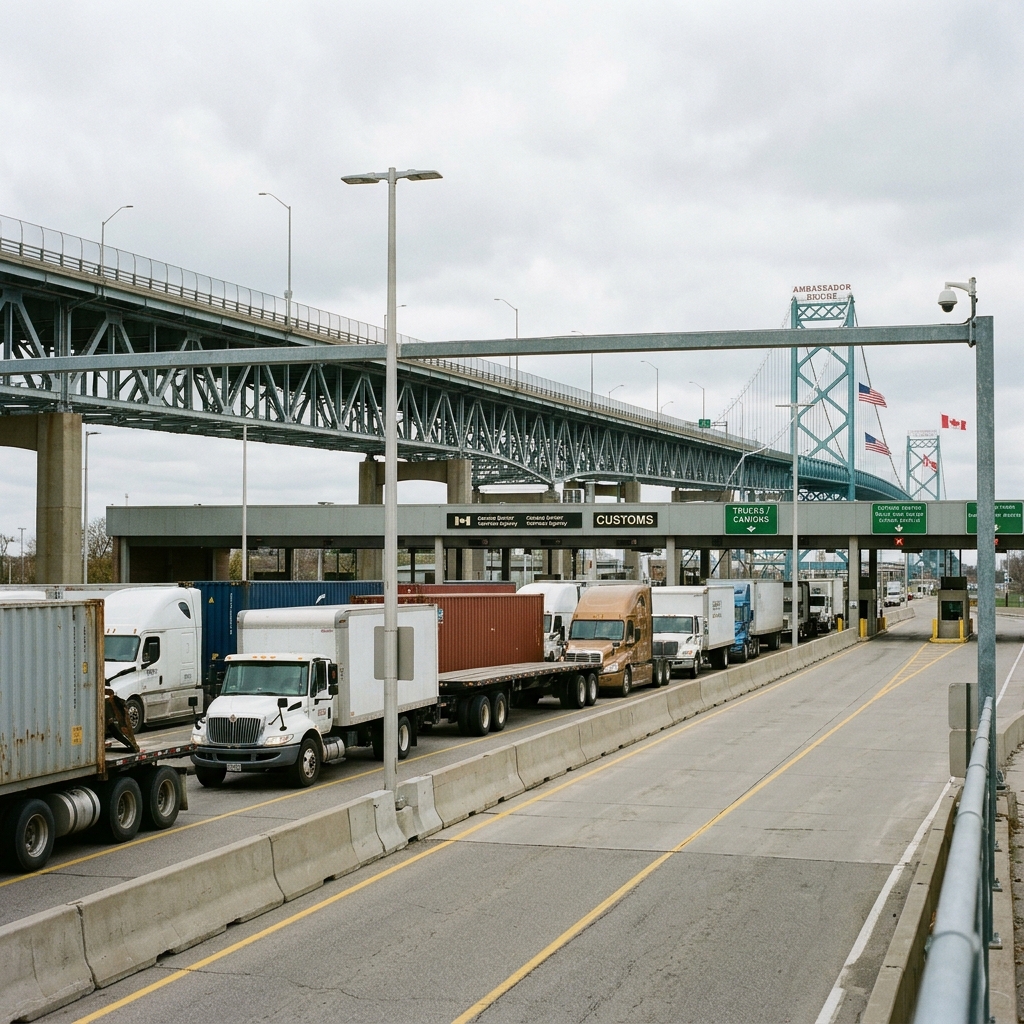
Ottawa Confronts the Specter of a 25 Percent Border Tax
President-elect Donald Trump has renewed his threat to slap a 25 percent tariff on all goods arriving from Canada and Mexico. The warning rattled executive suites from Calgary to Bay Street. At stake is roughly 3.6 billion Canadian dollars in merchandise crossing through US Customs and Border Protection and the Canada Border Services Agency every day. In a recent analysis published by the Fraser Institute and circulated through EnergyNow, economists argue Ottawa must avoid the impulse to hit back with reciprocal duties. Defensive trade barriers will only accelerate domestic inflation without changing minds in Washington.
The trading relationship between the two nations is deeply intertwined. Parts cross the border multiple times inside integrated automotive lines, while critical minerals and crude head south in massive volumes. Nearly 70 percent of Canadian merchandise exports flow through bottlenecks like the Ambassador Bridge, the Blue Water Bridge, and the CPKC rail network. Placing retaliatory tariffs on American components means Canadian factories pay twice: first when parts arrive at the plant, and again when finished products reach US border checkpoints. Historical precedents like the 1930 Smoot-Hawley Tariff Act and the 2018 steel disputes prove that tit-for-tat escalation hurts both economies.
Canada faces steep risks because trade drives over 60 percent of its gross domestic product. Bank of Canada officials have warned that broad American protectionism could stall Canadian growth and require fast monetary intervention. If the incoming White House invokes the International Emergency Economic Powers Act to bypass standard USMCA dispute mechanisms, Ottawa will have little legal room to maneuver. Fraser Institute analysts urge federal and provincial leaders to rethink their entire strategy. Instead of reactive political spats, Canada needs long-term policies that build competitive strength on its own merits.
The Mechanics of Self-Inflicted Wounds in Retaliatory Trade
Retaliatory tariffs sound decisive during parliamentary debates, but in practice, they function as a direct consumption tax on local businesses and households. Ottawa saw this firsthand in 2018 after applying surtaxes to 16.6 billion Canadian dollars of US steel, aluminum, and retail goods, with Canadian importers paying the freight. Canada buys about 15 percent of US exports, but the US market takes almost three-quarters of Canada's outbound shipments. This vast trade imbalance leaves Ottawa holding the weaker hand, turning dollar-for-dollar tariff fights into a losing bet for Canadian officials.
Factories across southern Ontario and Quebec cannot operate without steady deliveries of American goods. Machine tools, industrial plastics, and bulk chemicals move daily through the Detroit-Windsor and Buffalo-Fort Erie corridors. If the Department of Finance places duties on these shipments, local assembly costs will jump overnight. The Fraser Institute points out that higher overhead undermines Canadian manufacturers against competitors in Europe and Asia. Added duties also feed headline inflation, complicating rate decisions for the Bank of Canada as it watches moves by the Federal Reserve.
Hitting back also burns bridges with US governors who value bilateral commerce. Around nine million American jobs depend on trade and investment with Canada, especially in industrial centers across Ohio, Michigan, and Pennsylvania. Slapping Canadian tariffs on American farm products or engines punishes the very state officials Ottawa needs to persuade the White House. The Fraser Institute suggests leaving Canadian borders open to US products without new duties. This posture keeps Canada dependable and cost-effective, leaving American consumers to absorb the full price shock created by their own government's policy.
Dismantling Internal Trade Walls to Absorb External Shocks
Canada holds an effective shield against foreign trade shocks within its own borders, yet politicians have ignored it for decades. The Fraser Institute paper reports that interprovincial trade barriers create an implicit tax averaging about 7 percent across the country. Incompatible trucking rules, fragmented professional licensing, and provincial liquor monopolies act as permanent drags on business. Economic estimates cited in the analysis indicate that dropping these domestic barriers would lift national GDP by 4 to 7 percent, injecting roughly 90 billion Canadian dollars into the economy.
Provincial transport rules highlight the absurdity of these self-imposed barriers along the Trans-Canada Highway. Differing axle weight limits, tire rules, and driver rest mandates across Alberta, Saskatchewan, and Manitoba regularly force freight carriers to split loads or reroute trucks. In practice, long-haul rigs often move more easily into US border states under standardized interstate pacts than between neighboring Canadian provinces. The Fraser Institute wants all provinces to adopt a mutual-recognition framework, ensuring that any product or professional credential approved in one province is accepted across the entire country.
Clearing domestic trade hurdles generates genuine private business activity without running up government debt. The federal cabinet holds enough constitutional authority under the Canadian Free Trade Agreement and the Internal Trade Finance Committee to dismantle provincial market restrictions. Unlocking commerce between provinces would broaden domestic sales for natural resources, factory goods, and services, softening the blow of US trade disputes. Stronger domestic supply lines also trim operational costs for Canadian producers, helping them stay afloat even if US customs agents collect tariffs at border crossings.
Energy Infrastructure and Tax Realignment Ahead of the 2026 USMCA Review
Canada possesses critical economic leverage through its energy exports, and the Fraser Institute argues that Ottawa must play this card wisely. Canadian pipeline networks send roughly 4 million barrels of crude oil every day to refineries along the Gulf Coast and across the Midwest. Enbridge Line 5 alone moves over half the crude oil and propane used across Michigan and Ohio. A 25 percent tax on Western Canadian Select would immediately squeeze margins for American refineries and push up gasoline prices for US drivers. Canadian officials should bring these numbers to the incoming administration to show that taxing Canadian crude simply penalizes US industry.
Beyond energy pipelines, the Fraser Institute calls for major changes to the Canadian corporate tax system to stay competitive with the US market. The 2017 US Tax Cuts and Jobs Act dropped the American statutory federal corporate rate to 21 percent, erasing a long-standing advantage held by Canadian firms. Capital investment per worker in Canada has dropped steadily against US levels since 2015 due to regulatory backlogs, carbon pricing, and sluggish capital cost allowances. Trimming federal corporate tax rates and allowing full, permanent write-offs on machinery and equipment purchases would keep industrial capital inside the country.
The scheduled 2026 joint review of the US-Mexico-Canada Agreement sets the deadline for these reforms. If Canadian leaders spend the next two years fighting short-term tariff battles, they will sit down at the bargaining table in a weak position. The Fraser Institute's roadmap focuses on domestic investment, open trade between provinces, and reliable energy supplies. By clearing red tape around resource developments and maintaining fiscal restraint, Canada can demonstrate that North American security depends on a practical, integrated economic partnership rather than an expensive trade conflict.