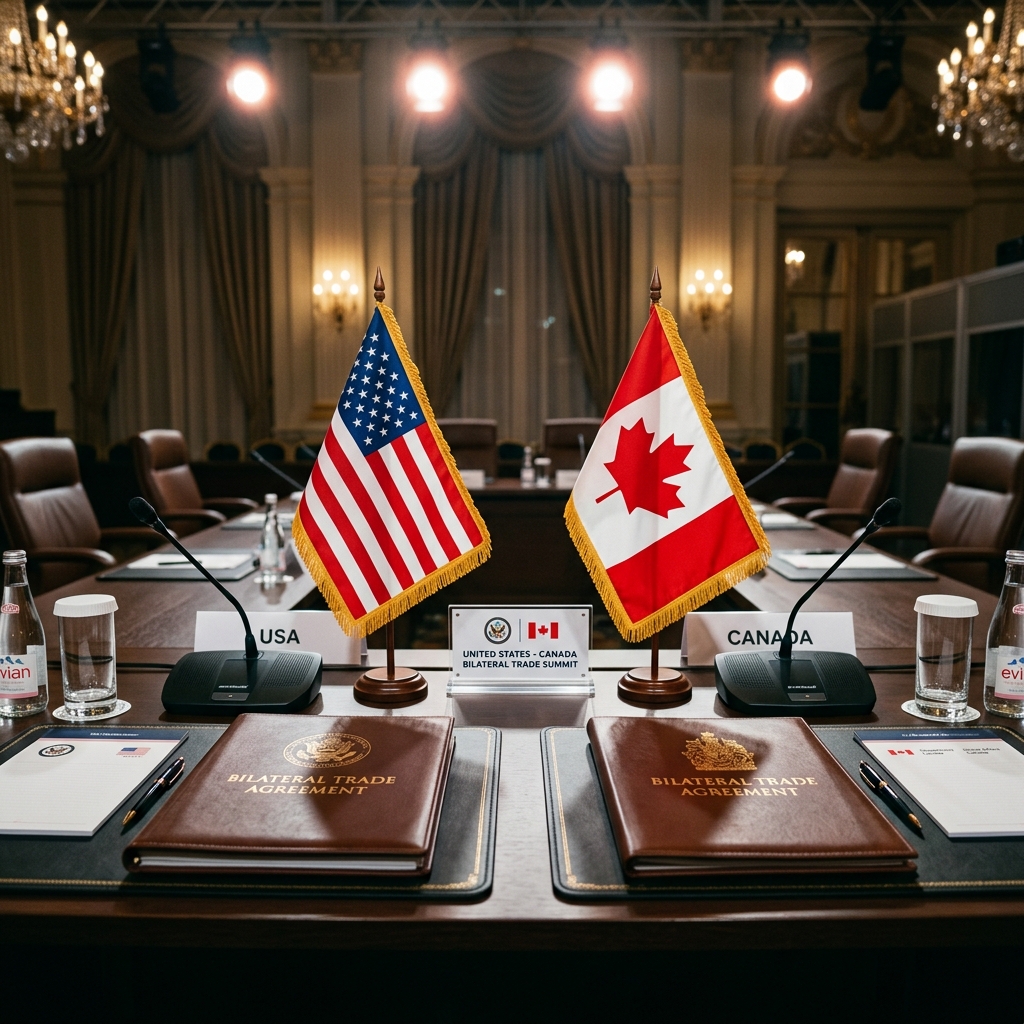
1. The Approaching 2026 USMCA Sunset & Joint Review Clause
Under Article 34.7 of the United States-Mexico-Canada Agreement (USMCA), 2026 marks the mandatory six-year Joint Review milestone where all three member nations must formally confirm their commitment to extend the treaty for an additional 16-year term.
What was originally designed as a routine administrative audit has transformed into a contentious geopolitical forum. Lawmakers in Washington and Ottawa face intense domestic lobbying from agricultural coalitions, industrial manufacturing unions, and technology conglomerates seeking to renegotiate critical market access provisions.
The stakes could not be higher: bilateral Canada-US commercial trade eclipsed $900 billion USD in 2025, supporting an estimated 2.3 million export-dependent jobs across Ontario, Quebec, Michigan, Ohio, and New York State.
2. Digital Services Taxes (DST) and Retaliatory Trade Measures
The primary catalyst for recent diplomatic friction is Canada's enactment of a unilateral 3% Digital Services Tax targeting large multinational tech enterprises generating significant digital revenue from Canadian consumers.
The Office of the United States Trade Representative (USTR) has officially initiated dispute settlement consultations, arguing that the tax discriminates disproportionately against American tech firms in violation of USMCA Chapter 15 (Digital Trade).
Congressional leaders representing manufacturing and agricultural districts have proposed retaliatory Section 301 tariffs on Canadian energy exports, automotive components, and softwood lumber if an OECD-harmonized multilateral consensus is not reached before year-end.
3. Automotive Rules of Origin & The Electric Vehicle Race
The automotive corridor connecting Southern Ontario with the US Midwestern 'Auto Alley' remains the industrial heart of the cross-border economy. Under USMCA rules, vehicles must achieve 75% Regional Value Content (RVC) to qualify for duty-free transit across the border.
With over $35 billion in joint public and private capital deployed into battery gigafactories in St. Thomas, Windsor, and Detroit, cross-border OEMs face stringent local sourcing rules for critical minerals—including lithium, nickel, and cobalt.
Supply chain logistics operators have adapted by implementing automated RFID tracking and digital customs declarations to prevent multi-hour border choke points along key transit bridges.
4. Strategic Outlook & Corporate Risk Mitigation
Corporate treasurers and supply chain directors are actively stress-testing dual-sourcing architectures to mitigate policy volatility. Foreign exchange hedging desks in Toronto and New York report elevated demand for multi-month USD/CAD forward contracts.
Industry consensus across the Canadian Chamber of Commerce and the US National Association of Manufacturers emphasizes that full USMCA renewal remains the overwhelmingly probable baseline outcome, given the catastrophic economic costs of reciprocal tariff escalation.
However, the path to renewal will require pragmatic compromises on agricultural quota transparency, digital commerce thresholds, and harmonized carbon border adjustment mechanisms.