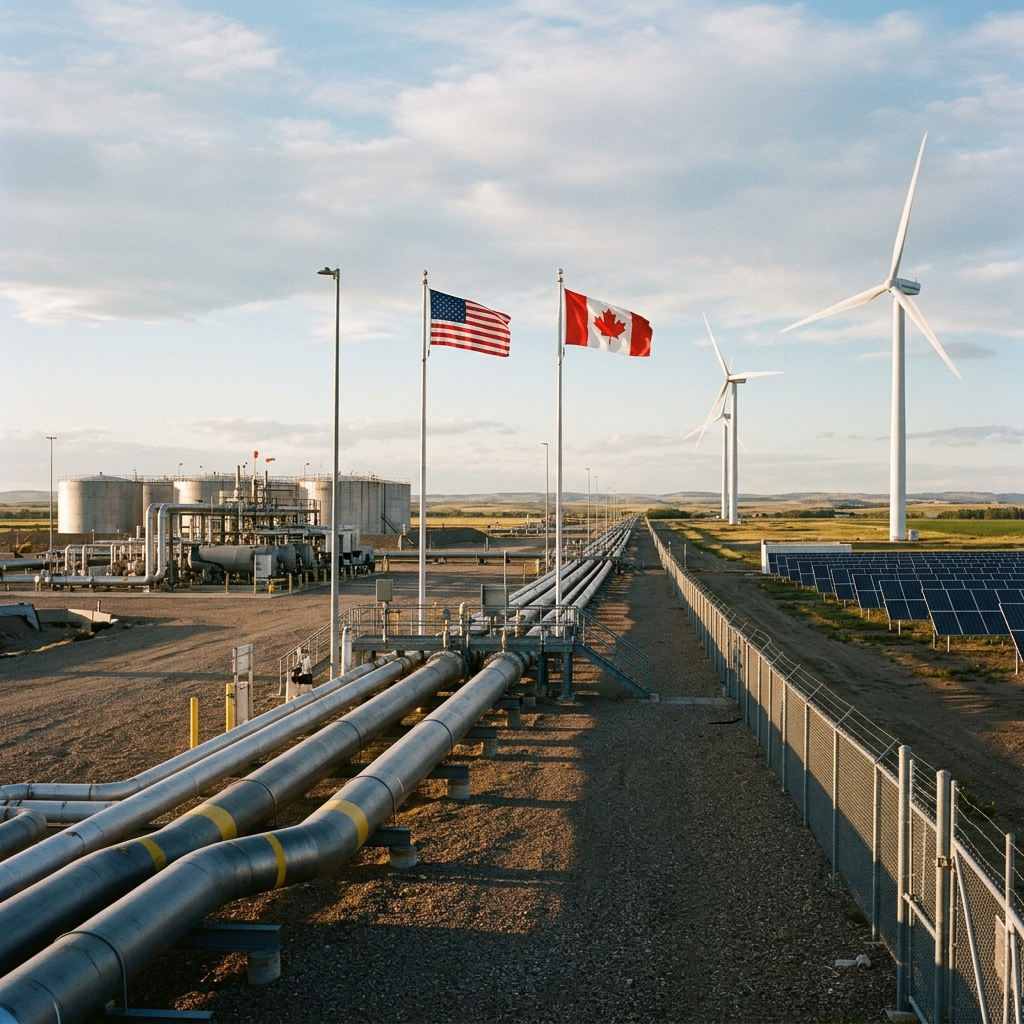
1. Resurrecting Keystone XL as a Bilateral Bargaining Asset
President-elect Donald Trump has thrust the long-dormant Keystone XL pipeline back into bilateral negotiations between Washington and Ottawa, according to reporting from La Voce di New York. The 1,210-mile infrastructure asset, originally conceived to transport 830,000 barrels per day of Western Canadian Select heavy crude from Hardisty, Alberta, to Steele City, Nebraska, was revoked by President Joe Biden on his first day in office in January 2021. Trump now intends to use the promise of renewed Presidential Permits as a diplomatic mechanism to extract commercial concessions from Canada ahead of the formal 2026 review of the United States-Mexico-Canada Agreement.
The political maneuver fundamentally alters the tenor of cross-border trade discussions, which had previously centered on defensive measures against Trump's proposed blanket 25 percent universal import tariffs. By introducing energy infrastructure into the calculus, the incoming administration seeks to bind Canadian heavy oil supply directly to American refining capacity along the Texas and Louisiana Gulf Coast. For Ottawa, the proposal arrives at a complex juncture, forcing Prime Minister Justin Trudeau's government to reconcile national decarbonization goals and the federal oil and gas emissions cap with an unexpected offer of expanded pipeline egress into the Midwest.
Market participants in Calgary and Houston view the sudden political revival with measured skepticism. The original Keystone XL project represented an eight billion dollar capital undertaking that resulted in hundreds of millions of dollars in asset write-downs for TC Energy Corporation and an estimated 1.3 billion dollar equity loss for the Alberta provincial government. Reviving the corridor requires navigating executive fiat in Washington, as well as an overhauled North American corporate significant where pipeline operators have actively divested heavy oil infrastructure to placate ESG-focused institutional investors.
2. Structural Realities for South Bow, TC Energy, and Midstream Capital
The corporate apparatus that initially pursued Keystone XL no longer exists in its prior structure. In the autumn of 2024, TC Energy completed the strategic spinoff of its liquids pipelines segment into an independent, publicly traded entity named South Bow Corporation. Headquartered in Calgary, South Bow now holds the legacy Keystone pipeline system, which carries approximately 622,000 barrels per day to Wood River, Patoka, and Cushing, but management has deliberately structured its capital allocation framework around conservative debt repayment rather than speculative greenfield developments.
Securing private capital to finance a resurrected corridor presents an extraordinary hurdle for institutional midstream financiers. The original pipe segments that were laid in 2020 have either been unearthed, recycled, or sold off to mitigate holding costs, while steel supply chains face severe inflationary pressure from existing Section 232 tariffs. Analysts note that no major North American infrastructure fund is likely to commit billions of dollars to cross-border pipe without binding, thirty-year ship-or-pay tolling commitments from oil sands producers who are already disciplined about capital returns.
Furthermore, TC Energy formally dismissed its 15 billion dollar legacy claim under the North American Free Trade Agreement legacy provisions in 2021 after US courts blocked construction permits under the National Environmental Policy Act. Reopening the corridor would require entirely fresh environmental impact statements through the US Army Corps of Engineers and the Department of State, exposing any commercial joint venture to sustained litigation from environmental groups across Montana, South Dakota, and Nebraska.
3. Gulf Coast Refining Economics and Changing Alberta Egress Flows
The crude marketing environment has changed dramatically since Keystone XL was canceled four years ago. The completion of Canada's federally owned Trans Mountain pipeline expansion in early 2024 unlocked an additional 590,000 barrels per day of egress toward Pacific tidewater at Westridge Marine Terminal in Burnaby, British Columbia. This structural shift has permanently diversified Canadian crude deliveries, granting producers alternative export routes into refineries across California, China, India, and Japan, thereby narrowing the historical Western Canadian Select discount against West Texas Intermediate.
Despite this westward outlet, complex US Gulf Coast refineries configured with specialized coking capacity still require uninterrupted feedstock of heavy sour crude. American operators along the Houston Ship Channel and Port Arthur have contended with declining production volumes of Mexican Maya crude and persistent geopolitical volatility surrounding Venezuelan barrels. Access to incremental, reliable volumes from Alberta's Athabasca oil sands remains commercially compelling for refiners like Valero Energy, Phillips 66, and Marathon Petroleum, who rely on heavy feedstocks to optimize high-margin distillate and petroleum coke yields.
If a revised bilateral trade agreement exempts Canadian energy products from potential US tariffs in exchange for fast-tracked pipeline authorizations, US downstream refiners would secure low-cost, politically stable feedstock for decades. However, commercial producers in the Western Canadian Sedimentary Basin must determine whether capital expenditures are best directed toward expanding upstream production beyond current levels of roughly five million barrels per day, or maintaining disciplined shareholder returns through dividends and share buybacks.
4. USMCA Renegotiation Dynamics and the Cross-Border Regulatory Maze
The deployment of Keystone XL as economic leverage serves as an opening gambit for the 2026 USMCA sunset clause renegotiations. Trump's trade advisors view access to the vast American consumer and industrial marketplace as a transactional tool to dismantle Canadian trade barriers, ranging from supply-managed dairy quotas to the newly enacted Digital Services Tax. By dangling the revival of the cross-border pipeline, Washington attempts to divide Canadian interests, aligning conservative leaders in energy-rich Alberta against federal policymakers in Ontario and Quebec.
Alberta Premier Danielle Smith has vocally supported cross-border pipeline expansion, signaling that the province would welcome renewed access to American industrial customers. However, regulatory authority over cross-border infrastructure remains firmly situated between the Canada Energy Regulator in Calgary and the US Department of State in Washington. Coordinating federal approvals demands unprecedented alignment across regulatory bodies that operate with fundamentally incompatible statutory mandates regarding climate policy, greenhouse gas accounting, and indigenous rights.
Legal scholars emphasize that even an explicit executive order from the White House granting a Presidential Permit under the Commerce Clause cannot shield a pipeline project from domestic legal challenges under the Endangered Species Act and the Clean Water Act. The Eighth Circuit Court of Appeals and various federal district courts historically halted Keystone XL construction over localized water crossing approvals. As a result, cross-border corporate dealmakers must treat any political revival of Keystone XL not as a guaranteed construction program, but as an opening chess move in a tense economic negotiation.