1. Diplomatic Momentum Reported via Upper Midwest Broadcast Hub
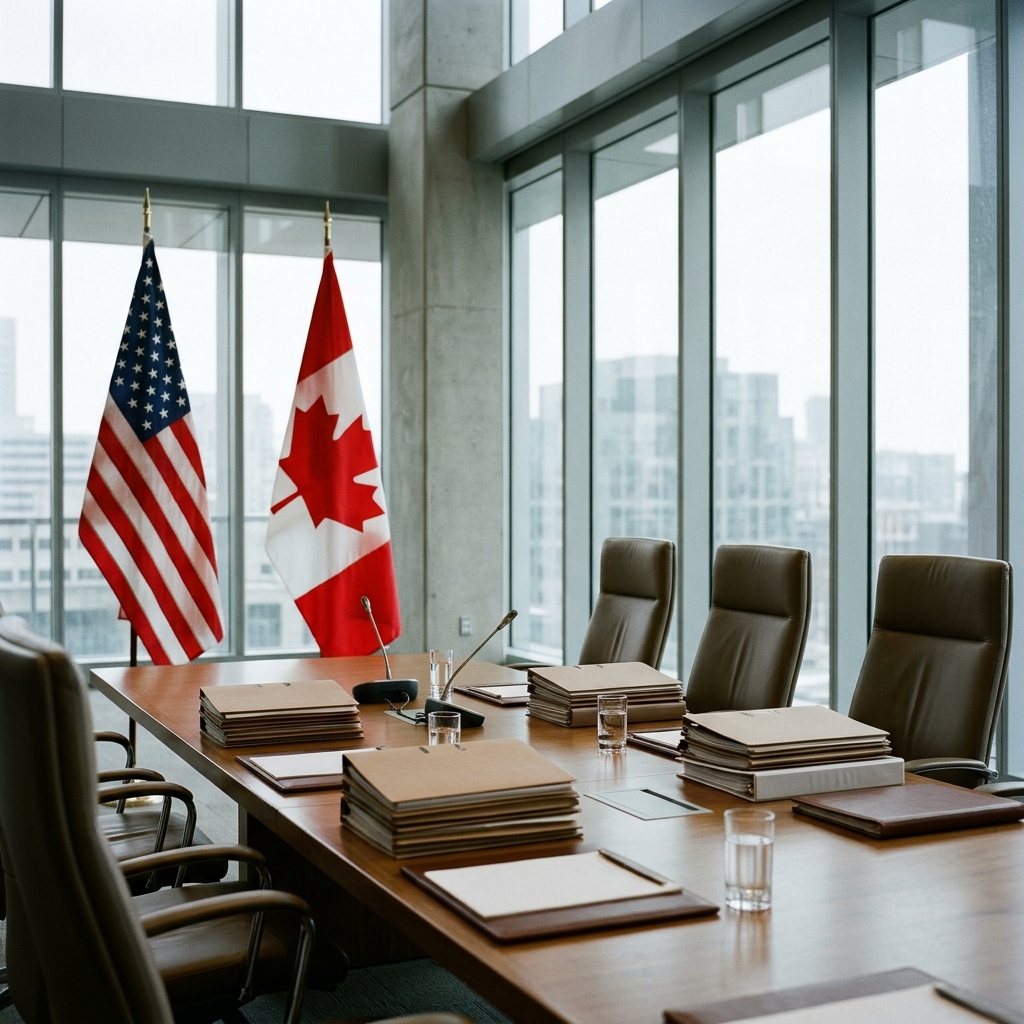
Regional coverage from The Mighty 790 KFGO in Fargo, North Dakota, has spotlighted remarks from Donald Trump indicating that the United States is rapidly closing in on a comprehensive trade pact with Ottawa. The station, a dominant commercial voice across the northern Red River Valley trade corridor, captured Trump's assessment following intensive discussions with Canadian Prime Minister Justin Trudeau and federal trade representatives. The sudden shift in tone provides critical relief for cross-border logistics operators along Interstate 29 and rail links operated by Canadian Pacific Kansas City, which carry billions of dollars in bulk agricultural commodities and refined fuel weekly.
The declaration marks a tactical recalibration from earlier threats to impose a sweeping 25 percent across-the-board tariff on all Canadian imports via the International Emergency Economic Powers Act. Trump indicated that negotiations advanced significantly following high-level delegations dispatching from Ottawa to Mar-a-Lago, led by Public Safety Minister Dominic LeBlanc. Officials focused directly on border interdiction metrics, enforcement protocols at ports of entry, and collaborative security frameworks. KFGO reported that the prospective framework aims to balance aggressive enforcement expectations with the preservation of tariff-free movements for certified goods covered by existing trade statutes.
Ottawa responded through coordinated briefings from the Privy Council Office and Global Affairs Canada, signaling that technical negotiating teams are drafting operational protocols rather than reopening the underlying legal text of the United States-Mexico-Canada Agreement. Deputy Prime Minister Chrystia Freeland maintained direct communication with US transition advisers, emphasizing that northern border crossings process high-volume, integrated industrial components rather than asymmetric consumer surpluses. The regional report underscores that both capitals recognize the prohibitive domestic inflationary costs of fracturing integrated North American manufacturing networks during a volatile monetary cycle.
2. Security Concessions and Regulatory Architecture of the Emerging Pact
The emerging bilateral understanding hinges on Ottawa committing substantive capital to secure its perimeter, directly linking cross-border tariff relief to national security benchmarks. Canadian negotiators pledged an initial four billion dollar procurement package targeting enhanced surveillance drones, thermal imaging helicopters, and expanded Royal Canadian Mounted Police deployments along isolated sectors of the Quebec, Ontario, and Prairie borders. By addressing White House demands regarding illicit fentanyl precursors, unregulated maritime imports, and non-citizen transit routes, Canada seeks to neutralize statutory justifications for unilateral Section 232 or IEEPA import penalties before administrative executive orders take effect.
A central component of the compromise involves synchronized foreign direct investment screening, targeted primarily at third-party circumvention from Chinese industrial entities. Investment Canada Act thresholds will be recalibrated to mirror standards enforced by the Committee on Foreign Investment in the United States, particularly concerning critical mineral processing in northern Ontario and lithium deposits in Quebec. By harmonizing capital reviews, Canada intends to assure Washington that the domestic supply ecosystem will not function as a backchannel for subsidized steel, aluminum, or electric vehicle components seeking duty-free entry into Midwest manufacturing hubs.
Regulatory harmonization extends to maritime container inspection protocols at the Port of Vancouver and the Port of Montreal. The Canada Border Services Agency agreed to integrate automated manifest tracking systems with US Customs and Border Protection targeting high-risk oceanic cargo before intermodal transfer to CN Rail and CPKC freight lines. This multi-layered enforcement posture mirrors the pre-clearance provisions of the 21st Century Border Management Initiative, establishing verifiable security checkpoints that allow the White House to claim political victory while leaving cross-border freight conduits entirely operational.
3. Commodity Dynamics, Automotive Integration, and Currency Repricing
Foreign exchange and fixed-income desks quickly adjusted pricing following the report aired on KFGO. The Canadian dollar rallied from four-year lows against the greenback, gaining over 65 basis points as foreign exchange traders pared back aggressive short positions premised on a full-scale bilateral tariff dispute. Yield spreads between Government of Canada ten-year benchmark bonds and US Treasuries narrowed, signaling reduced credit risk premiums for Canadian corporate issuers heavily dependent on export liquidity into northern US consumer and industrial markets.
Nowhere is the avoidance of punitive duties more existential than in the Great Lakes automotive manufacturing cluster, governed by the Automotive Parts Manufacturers' Association and motor vehicle assembly facilities in Windsor and Oshawa. Intermediate components frequently traverse the Ambassador Bridge and the Detroit-Windsor Tunnel up to eight times before final vehicle assembly. A blanket 25 percent levy would have rendered just-in-time logistics impossible, paralyzing operations for Ford, General Motors, and Stellantis while causing immediate double-digit production drops across engine casting facilities throughout Michigan and Ohio.
The energy corridor represents an equally critical dimension of the preliminary accord, centered on Western Canadian Select heavy crude flowing into Gulf Coast and Midwest refineries via Enbridge Line 3 and Line 5. Imposing tariffs on the daily flow of nearly four million barrels of Canadian crude would have triggered immediate refinery margin compression and retail gasoline spikes across the American Upper Midwest. By confirming that energy commodities remain insulated from impending trade measures, both administrations have preserved margin stability for integrated producers, pipeline operators, and independent refining complexes.
4. USMCA Joint Review Realities and Corporate Strategic Execution
While the statements broadcast by KFGO establish near-term operational certainty, institutional risk managers view the development as an opening gambit ahead of the mandatory 2026 USMCA Joint Review. Under Article 34.7 of the agreement, each signatory must formally declare whether to extend the trilateral pact for an additional sixteen-year term. Trump's willingness to leverage unilateral trade threats demonstrates that Ottawa must prepare for sustained structural pressure concerning supply-managed dairy quotas, digital services taxation, and defense expenditures mandated by NATO spending baselines.
Corporate leadership across the cross-border corridor is deploying concrete defensive strategies to manage trade volatility throughout the transition period. Multinational logistics firms are establishing parallel customs compliance divisions to audit rules-of-origin documentation under current Uniform Regulations, ensuring zero non-originating content exceeds established fractional limits. Furthermore, Canadian industrial exporters are accelerating warehouse leases in border states including New York, Michigan, and North Dakota to maintain buffer inventories of finished sub-assemblies in case administrative mandates change unexpectedly.
The report delivered by The Mighty 790 KFGO serves as a vital reminder of the deep, reciprocal integration tying the US Upper Midwest directly to Canadian raw materials, equipment, and consumer goods. For investors, corporate boards, and trade adjudicators, the preliminary accord outlines a functional blueprint: Canada will concede measurable national security and border enforcement expenditures to safeguard foundational trade access. The coming months will test whether this transactional compromise can withstand domestic political crosswinds and provide durable stability through the formal USMCA renegotiation cycle.