1. Diplomatic Momentum and Tariff De-escalation Mechanics
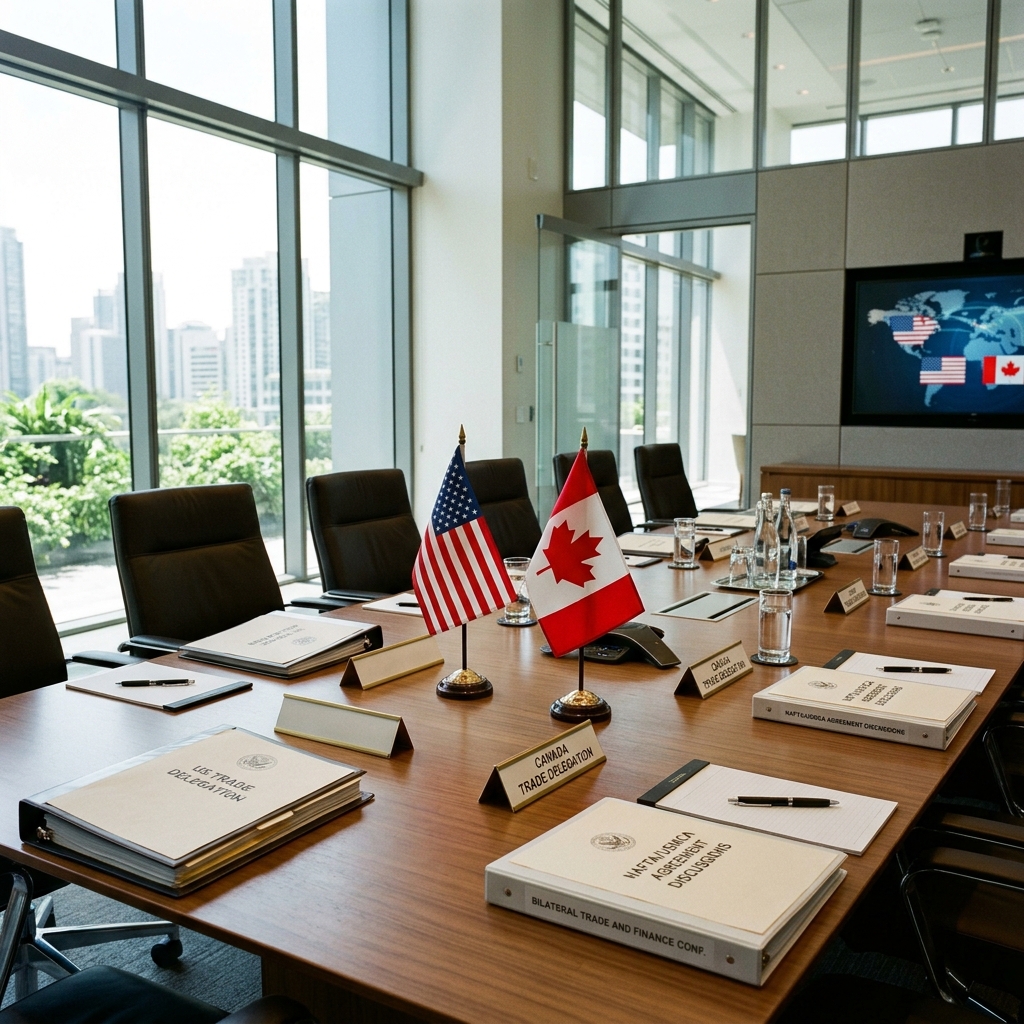
Statements by Donald Trump indicating that the United States is close to finalizing a trade agreement with Canada mark an abrupt shift from punitive tariff threats toward structured bilateral dealmaking. The declaration follows weeks of intense diplomatic back-channeling after Washington threatened across-the-board tariffs under the International Emergency Economic Powers Act. Canadian ministerial delegations, coordinated through the Prime Minister's Office and Global Affairs Canada, presented verified enforcement proposals in Washington and Florida. The prospect of an imminent accord removes immediate downside tail-risks for integrated North American manufacturing networks that faced severe operational dislocation under potential twenty-five percent import duties.
Ottawa responded to executive branch leverage by decoupling its trade messaging from standard multilateral forums, directly engaging key transition advisers and congressional trade committees. Deputy Prime Minister Chrystia Freeland and public safety officials assembled a package focused on border interdiction, joint intelligence sharing, and tightened customs screening. This targeted approach reassured American negotiators that Canadian entry points would not serve as secondary conduits for illicit narcotics or non-compliant steel transshipments. By addressing specific White House grievances directly, Canada created a viable path toward a bilateral memorandum that preserves broad reciprocal tariff exemptions without requiring emergency domestic legislative remedies.
Foreign exchange and fixed-income markets responded swiftly to the announcement, reflecting immediate relief among institutional investors holding Canadian assets. The Canadian dollar rallied against the greenback, recovering losses triggered by earlier protectionist rhetoric, while the yield spread between Government of Canada ten-year benchmarks and US Treasuries compressed. Equities linked to cross-border logistics, including Canadian Pacific Kansas City and Canadian National Railway, experienced immediate valuation adjustments. Corporate treasurers, who had been actively hedging bilateral receivables against severe tariff-induced volatility, are now recalibrating currency exposure assumptions under the emerging stability framework.
2. Core Concessions: Border Security, Steel Transshipment, and Digital Taxes
The substantive foundation of the anticipated pact centers on concrete enforcement metrics rather than traditional duty rate reductions. Canadian negotiators have committed billions of dollars in new capital expenditures toward border surveillance infrastructure, deployable patrol helicopters, and non-intrusive rail scanning technologies along the forty-ninth parallel. The Canada Border Services Agency will synchronize intelligence protocols directly with US Customs and Border Protection to target maritime freight entering ports in Vancouver, Montreal, and Halifax. By demonstrating measurable operational containment of third-country cargo, Canadian officials satisfied primary American requirements concerning supply chain integrity.
Agricultural and technical trade disputes also feature prominently in the final negotiating rounds, particularly American access to Canada's supply-managed dairy sector. Washington trade representatives have long challenged Canadian tariff-rate quota administration under USMCA Chapter 3, arguing that administrative restrictions prevent American processors from accessing their agreed market shares. In exchange for permanent tariff exemptions on energy and industrial inputs, Ottawa appears willing to adjust quota distribution mechanisms for fluid milk and cheese. Furthermore, Canada's proposed Digital Services Tax, which drew intense bipartisan opposition from the US House Ways and Means Committee, is undergoing procedural reassessment to align with bilateral compliance expectations.
Critical mineral integration and energy flows serve as Washington's primary economic incentive to formalize terms swiftly with Ottawa. The United States remains deeply dependent on Canadian imports of heavy crude oil via Enbridge Mainline networks, refined aluminum, and unprocessed nickel required for defense and battery manufacturing. Imposing severe duties on these upstream industrial inputs would directly undermine domestic industrial expansion goals and amplify inflationary pressures across American manufacturing centers. By institutionalizing an energy and security compact within the broader trade understanding, both governments ensure continuous pipeline deliveries and unhindered metallurgical trade across the northern border.
3. Automotive Supply Chains and Rules of Origin Governance
The automotive corridor connecting Southern Ontario with Michigan, Ohio, and Indiana represents the most vulnerable node in cross-border trade governance. The Automotive Parts Manufacturers' Association and motor vehicle assemblers like General Motors, Ford, and Stellantis rely on specialized vehicle components crossing the Ambassador Bridge multiple times before final assembly. Trump's confirmation of progress toward an agreement eliminates an existential threat to this integrated ecosystem. Maintaining zero-tariff status requires strict adherence to USMCA Chapter 4 rules of origin, which demand seventy-five percent regional value content and seventy percent North American steel and aluminum procurement.
A critical condition within the emerging bilateral consensus involves preventing Chinese capital and parts suppliers from establishing intermediate assembly hubs inside Canada. Ottawa aligned its external tariff policy with Washington by imposing a one hundred percent surtax on Chinese-manufactured electric vehicles alongside tariffs on Chinese steel and aluminum. This synchronized protectionism assures American trade negotiators that the Canadian manufacturing base will not act as a back door for subsidized Asian components. This shared defensive perimeter safeguards joint investments made by the Canadian federal government and the Province of Ontario in domestic battery and cathode processing operations.
Labor value content requirements will also see reinforced verification standards under the pending agreement, directly affecting manufacturing wage dynamics across North America. To qualify for preferential tariff treatment, automakers must prove that forty to forty-five percent of vehicle content originates in facilities paying at least sixteen dollars per hour. Joint cross-border auditing units will expand inspections at regional assembly points to prevent fraudulent origin declarations. The Automotive Parts Manufacturers' Association confirmed that regional suppliers possess sufficient domestic sourcing capacity to meet these rigorous verifications, preserving cross-border assembly rhythms without triggering retaliatory customs inquiries.
4. Structural Implications for the 2026 USMCA Joint Review
The impending bilateral deal functions as an operational bridge toward the mandatory joint review of the USMCA scheduled for 2026 under Article 34.7. Rather than delaying disputes until that statutory milestone, the current compromise addresses unresolved administrative grievances in real time. Resolving flashpoints over automotive rules, digital taxation, and agricultural quotas now establishes a durable negotiating baseline for the three-nation pact, which also includes Mexico. This sequencing provides multinational corporations with multi-year regulatory visibility, enabling corporate boards to execute capital deployment decisions without the immediate threat of trade agreement termination.
Legal execution of the bilateral terms will likely rely on executive executive mechanisms and administrative memoranda of understanding rather than comprehensive treaty ratification. This technical approach bypasses the requirement for lengthy legislative reviews within the US Congress or formal statutory revisions in the Parliament of Canada. The United States Trade Representative will utilize existing delegated authorities to certify Canadian regulatory compliance, while Canadian ministries will implement necessary tariff-rate quota adjustments through Orders in Council. This procedural framework enables rapid implementation while maintaining enforcement triggers should either party fail to uphold border security or customs interdiction standards.
For corporate leaders and institutional asset managers, the de-escalation signals that structural interdependence continues to discipline executive trade policy in North America. Supply chain diversification away from cross-border dependencies has proven economically prohibitive for heavy manufacturing, chemical production, and forestry products. The confirmation of an imminent accord emphasizes that integrated logistics and shared industrial standards provide mutual economic resilience against external geopolitical shocks. Enterprise risk managers must nevertheless maintain rigorous customs documentation protocols, as future trade stability will increasingly depend on verifiable supply chain auditability and strict origin compliance.