1. Backchannel Diplomacy and the 2026 CUSMA Mandate
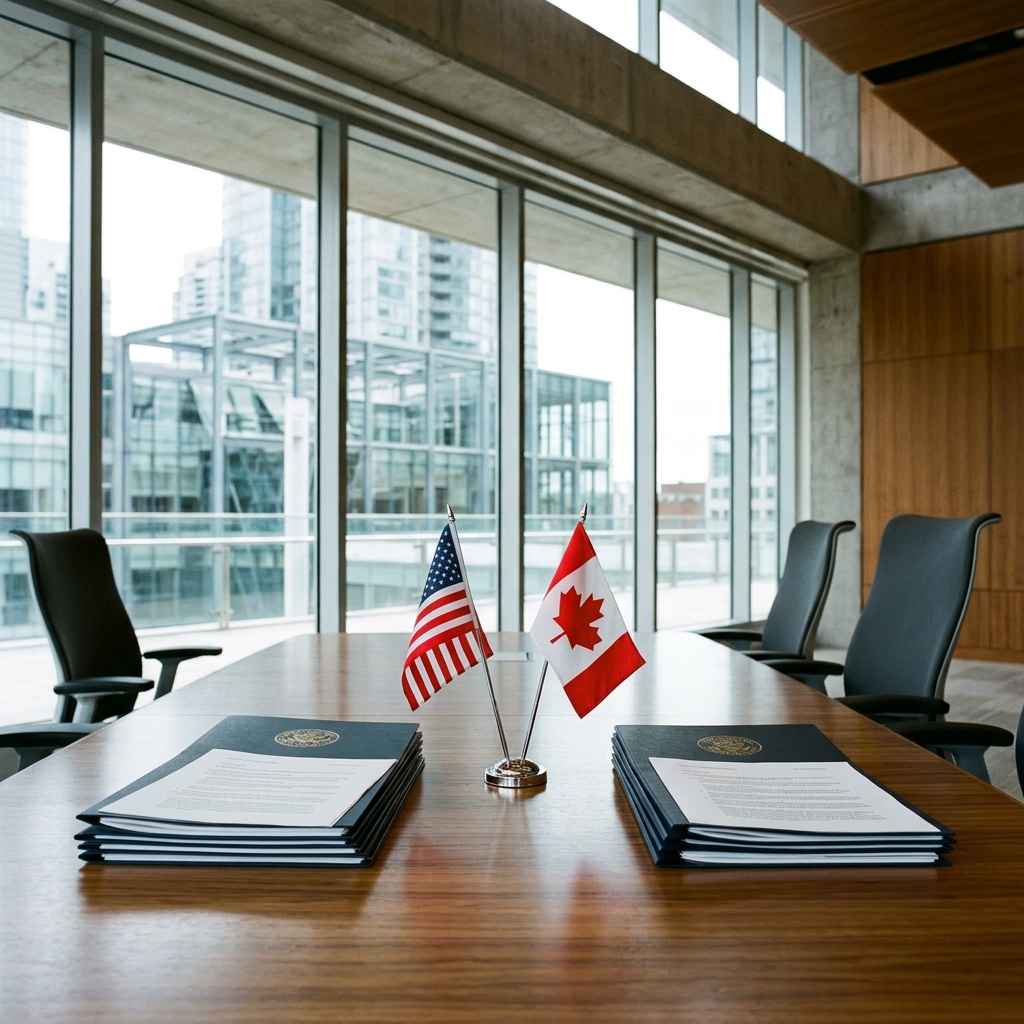
Unconventional backchannel overtures between Donald Trump and former Bank of Canada Governor Mark Carney point toward a pragmatic effort to preempt disruption ahead of the 2026 review clause embedded in the Canada-United States-Mexico Agreement. According to reporting from Finance and Commerce, these dialogues seek a bilateral consensus that circumvents unilateral tariff broadsides against Canadian industrial exports. Carney, who also led the Bank of England and chairs Brookfield Asset Management, brings institutional credibility across Bay Street and Wall Street. His involvement suggests institutional capital wants clarity on continental integration before political campaigns lock negotiators into intractable domestic postures.
The institutional mechanics of CUSMA Article 34.6 mandate a joint review in July 2026, wherein parties must formally confirm whether to extend the trilateral pact for another sixteen-year term. Trump has consistently criticized trilateral structures, repeatedly asserting that bilateral negotiations yield superior concessions for domestic manufacturing bases in Ohio, Michigan, and Pennsylvania. By testing an early bilateral architecture directly with Carney, the Republican administration in waiting seeks to separate Canadian resource flows from Mexican labor and transshipment controversies. This diplomatic channel offers Ottawa a roadmap to maintain preferential duty-free market access while addressing Washington trade enforcement priorities.
The talks emphasize that Canadian economic policy must actively counter circumvention by non-market states to retain uninhibited access to American consumer markets. Carney has conveyed that corporate boardrooms in Toronto, Montreal, and Calgary view access to the United States as an existential commercial requirement. Rather than risking a chaotic unilateral withdrawal via executive decree under Trade Expansion Act authorities, a structured pre-negotiation offers cross-border investors certainty. The framework outlined in the Finance and Commerce report reflects a transactional alignment: Canada protects its primary manufacturing and resource export corridors by aligning its external trade perimeter with Washington.
2. External Perimeter Harmonization and Critical Supply Chains
The core concession outlined within the Trump-Carney discussions involves Canada matching aggressive American Section 301 tariffs on Chinese industrial goods, particularly electric vehicles, steel, and aluminum. The Department of Finance in Ottawa recently implemented 100 percent surtaxes on Chinese electric vehicles and 25 percent levies on steel and aluminum imports to eliminate transshipment risks. Trump has stressed that the Great Lakes automotive ecosystem cannot tolerate backdoor Chinese entry through Canadian sub-assembly plants in southern Ontario. Matching these tariffs creates a unified North American defensive perimeter, neutralising one of the most potent arguments favored by Washington protectionists seeking punitive Canadian duties.
Critical minerals and clean industrial energy represent the second foundational pillar of the potential agreement. Trump has emphasized energy dominance, while Carney highlights the necessity of mobilizing private institutional capital for continental power grids and mineral supply chains. The United States faces persistent shortages of battery-grade lithium, nickel, cobalt, and rare earth elements needed for national defense systems and commercial manufacturing. Ontario's Ring of Fire and Quebec's lithium deposits offer domestic supply security that the Department of Defense can support through Title III of the Defense Production Act, effectively shielding Canadian extractors from future cross-border investment restrictions.
Cross-border energy trade remains uniquely insulated within this conceptual framework. Canadian crude shipments through the Enbridge Mainline and the expanded Trans Mountain pipeline provide essential heavy sour feedstock to Gulf Coast and Midwest refineries. Under the discussed framework, bilateral energy transactions would remain exempt from baseline tariff proposals. Carney has argued that imposing duties on Canadian energy imports would instantly spike consumer gasoline prices in swing states and inflate industrial overhead for American petrochemical plants. Recognizing this mutual dependency, both sides appear willing to preserve the zero-duty status of cross-border hydrocarbons, electricity grids, and pipeline systems.
3. Automotive Rules of Origin and Labor Content Requirements
Automotive supply chains across the Windsor-Detroit corridor face strict scrutiny under any renegotiated commercial terms between Washington and Ottawa. CUSMA established a 75 percent regional value content requirement alongside a labor value content threshold requiring 40 to 45 percent of vehicle components to be manufactured by workers earning at least sixteen dollars per hour. The Trump-Carney conversations examine tighter tracing mechanisms to ensure third-country electrical components, rare earth magnets, and microprocessors do not dilute continental content percentages. Canadian parts manufacturers represented by the Automotive Parts Manufacturers' Association would secure guaranteed operational access in exchange for rigorous provenance documentation across all tier-one and tier-two suppliers.
Labor dynamics create a rare area of structural parity between the United States and Canada that works to the disadvantage of Mexican assembly operations. Canadian autoworkers represented by Unifor work under collective agreements that far exceed the sixteen-dollar hourly wage floor, contrasting sharply with the independent union verification delays seen in Mexican industrial hubs. Trump trade advisors view Canadian labor as non-predatory, focusing their political opposition primarily on wage suppression south of the Rio Grande. By leaning into this high-wage parity, Carney and Canadian trade envoys position Canadian factories in Oshawa, Oakville, and Cambridge as direct allies to American industrial recovery rather than low-cost threats.
Agricultural disputes continue to generate friction, specifically Canada's supply-managed dairy sector, which remains a perpetual target for American dairy groups in Wisconsin and upstate New York. During original USMCA negotiations, Canada granted modest tariff-rate quotas, but American dairy exporters argue administrative barriers limit actual sales volumes. The Finance and Commerce report suggests that Carney and Trump explored adjustments to Canadian quota administration systems to pacify congressional agricultural lobbies. Resolving dairy compliance disputes early removes a reliable sticking point that could otherwise derail broader industrial agreements covering advanced manufacturing, energy integration, and financial technology.
4. Market Realities and Congressional Trade Authority Realignment
Any bilateral understanding conceived outside formal executive channels must ultimately navigate statutory obstacles within the United States Congress. Article I, Section 8 of the United States Constitution explicitly grants Congress authority over foreign commerce, meaning any structural alteration to CUSMA requires legislative implementation. While Trump has shown willingness to utilize Section 232 national security provisions or the International Emergency Economic Powers Act to alter trade flows unilaterally, enduring structural changes demand Trade Promotion Authority or dedicated legislative approval. Carney's private overtures demonstrate an awareness that securing durable economic access requires building multi-factional support across both Capitol Hill and Parliament Hill.
Financial markets have reacted to the reported Trump-Carney discussions with measured relief across Canadian sovereign debt and currency exchanges. The Canadian dollar has experienced downside volatility driven by widening interest rate differentials between the Bank of Canada and the Federal Reserve, combined with the overhang of potential ten percent universal tariffs. News of constructive bilateral frameworks targeting transshipment rather than broad-based Canadian duties reduces the risk discount applied to Toronto Stock Exchange equities. Institutional asset managers recognize that preserving tariff-free cross-border corridors protects capital-intensive sectors like railway freight, integrated steel fabrication, and diversified commercial banks operating across both jurisdictions.
The structural shift revealed by these discussions signals the end of passive, institutional trade pacts in favor of managed, geopolitical supply arrangements. Canada is being pressed to explicitly tie its foreign economic policy to Washington's strategic competition with systemic global rivals. Mark Carney's proactive engagement reflects a calculation that Ottawa cannot remain detached or rely solely on multilateral dispute settlement mechanisms at the World Trade Organization. To maintain privileged access to the largest consumer market on earth, Canada must accept a formalized role as an integrated economic and security partner within a fortified North American perimeter.