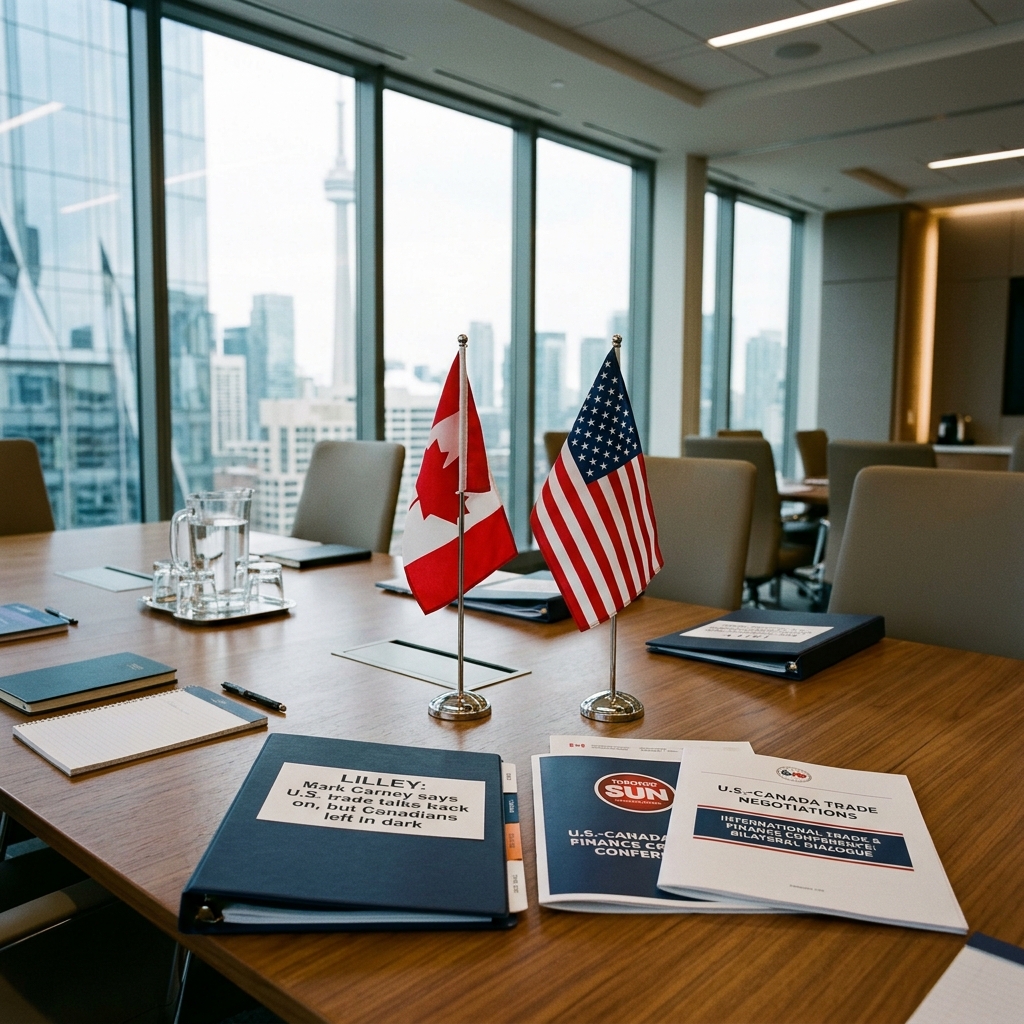
1. Backchannel Diplomacy and the Lilley Critique in the Toronto Sun
Reporting by Brian Lilley in the Toronto Sun has exposed a widening rift between the federal Liberal government and Canadian industrial stakeholders. Former Bank of Canada governor Mark Carney disclosed that bilateral trade talks with Washington are effectively underway, catching market observers and trade associations off guard. Lilley argues that Carney, acting as an informal economic adviser to Prime Minister Justin Trudeau, has circumvented typical institutional protocols. Canadian exporters, automotive manufacturers, and provincial premiers remain excluded from briefings, despite holding primary exposure to bilateral tariff exposure and cross-border regulatory adjustments.
The opacity highlighted by the Toronto Sun underscores institutional frustration across Ottawa and Bay Street. Carney operates without a cabinet portfolio or parliamentary accountability, yet his statements suggest direct backchannel engagement with United States trade figures. Lilley emphasizes that domestic manufacturers in Ontario and Quebec are effectively navigating blind, unable to discern which Canadian concessions are on the table. The lack of structured public readouts departs from traditional bilateral negotiating rounds historically led by Global Affairs Canada and the Department of Finance, eroding executive confidence in trade predictability.
Federal opposition critics and sector representatives have seized upon the Toronto Sun column to demand immediate transparency. Ottawa faces accusations of prioritizing political positioning over strategic domestic alignment. By granting Carney significant leeway to shape cross-border trade narratives without legislative oversight, the government risks alienating provincial partners whose jurisdictions absorb the direct shocks of American trade remedies. Lilley contends that keeping Canadians in the dark weakens Ottawa's domestic consensus precisely when unified bargaining strength is vital against aggressive protectionist posturing from Washington.
2. CUSMA 2026 Mandate and Looming Cross-Border Friction Points
The statutory driver behind these preliminary discussions is the upcoming six-year joint review of the Canada-United States-Mexico Agreement, codified under Article 34.7. Set for 2026, the review allows any party to trigger a formal termination sunset clause if bilateral grievances remain unresolved. Washington has repeatedly signaled discontent with Canadian compliance in critical commercial sectors. Central among these disputes are American dairy tariff-rate quotas, the federal Digital Services Tax targeting Silicon Valley technology giants, and lingering tensions over Canadian clean electricity export subsidies that compete against Rust Belt power utilities.
Carney’s informal overtures coincide with an increasingly aggressive stance from the Office of the United States Trade Representative. Trade Representative Katherine Tai has consistently warned that CUSMA compliance is non-negotiable, particularly regarding supply management protections for dairy farmers in Ontario and Quebec. If Carney’s discussions involve potential compromises on agricultural import barriers or cultural exemptions, domestic farm lobbies like the Dairy Farmers of Canada face unprecedented market disruption. Without formal public consultations, domestic sectors fear that backchannel negotiations will sacrifice supply management protections to secure automotive access.
Automotive supply chains clustered around Windsor, Detroit, and the Highway 401 corridor face equal vulnerability. Rules of origin mandates for electric vehicle batteries, regional value content calculations, and Section 232 steel and aluminum tariff threats require rigorous technical negotiations. When an economic adviser asserts that talks are underway without input from Canadian automotive parts manufacturers or the Canadian Association of Petroleum Producers, cross-border corporate planners cannot accurately forecast capital expenditures. Lilley notes that informal negotiations bypass the technical working groups that safeguard domestic manufacturing parity.
3. Governance Vacuum: Shadow Envoys Versus Institutional Trade Architecture
The reliance on Mark Carney highlights an unusual governance structure within the Prime Minister's Office. Historically, cross-border trade diplomacy fell under the purview of ministers sworn to Privy Council secrecy and held accountable in the House of Commons. International Trade Minister Mary Ng and Foreign Affairs Minister Mélanie Joly possess formal statutory mandates to lead these engagements. Carney’s external advisory capacity blurs jurisdictional lines, raising legal and regulatory questions regarding access to information requests, conflict of interest disclosures, and official records of foreign government discussions.
Financial institutions and foreign exchange desks are closely monitoring this blurred governance model. The Canadian dollar remains heavily sensitive to shifts in the terms of trade with the United States, which absorbs over 75 percent of Canadian merchandise exports. When major policy shifts are hinted at through informal economic envoys rather than formal Global Affairs Canada press releases, currency volatility spikes. Institutional investors require clear regulatory signals, not speculative commentary delivered at closed-door business symposiums or via selective media disclosures that evade parliamentary scrutiny.
Provincial leaders are growing vocal in their opposition to centralized, non-transparent trade management. Ontario Premier Doug Ford and Alberta Premier Danielle Smith have repeatedly insisted that subnational interests must be actively represented at the negotiating table, given their control over provincial resource extraction and industrial policy. Lilley’s analysis in the Toronto Sun validates provincial anxieties that Ottawa’s inner circle is privately discussing major commercial policies without consulting the provinces, repeating tactical missteps that previously complicated early North American Free Trade Agreement renegotiations.
4. Capital Allocation, Yield Spreads, and Corporate Strategic Fallout
Uncertainty generated by informal bilateral trade talks is directly affecting capital formation across the Canadian economy. Fixed-income markets evaluate the sovereign credit profile of Canadian corporate debt through the prism of secure access to the United States internal market. When trade talks restart without transparent public parameters, institutional asset managers demand higher credit spreads to compensate for tariff risks. Multi-year corporate capital expenditure programs in petrochemicals, critical minerals refining, and advanced aerospace require predictable regulatory treatment that shadow diplomacy cannot deliver.
Foreign direct investment decisions in Southern Ontario and Alberta depend on clear assessments of United States trade policy. Multinational enterprises weigh the risk of sudden American countervailing duties against domestic Canadian incentives like the Clean Technology Investment Tax Credits. If Carney’s discussions concede ground on reciprocal procurement rules or carbon border adjustments to appease American lawmakers, domestic business cases collapse. Chief financial officers are delaying major balance-sheet commitments until the Canadian government formalizes its negotiating team and publishes a definitive, legally binding agenda.
The Toronto Sun's revelation serves as an early warning for boardrooms across North America. To restore stability, corporate leaders and industry trade councils must demand that the federal government re-establish formal, institutional channels for trade negotiations. Relying on an unelected adviser to conduct ad-hoc trade messaging introduces political friction that weakens Canada's stance before the CUSMA review begins. Until Ottawa delivers fully transparent, public briefings on its cross-border posture, Canadian enterprises will remain exposed to sudden geopolitical trade shifts.