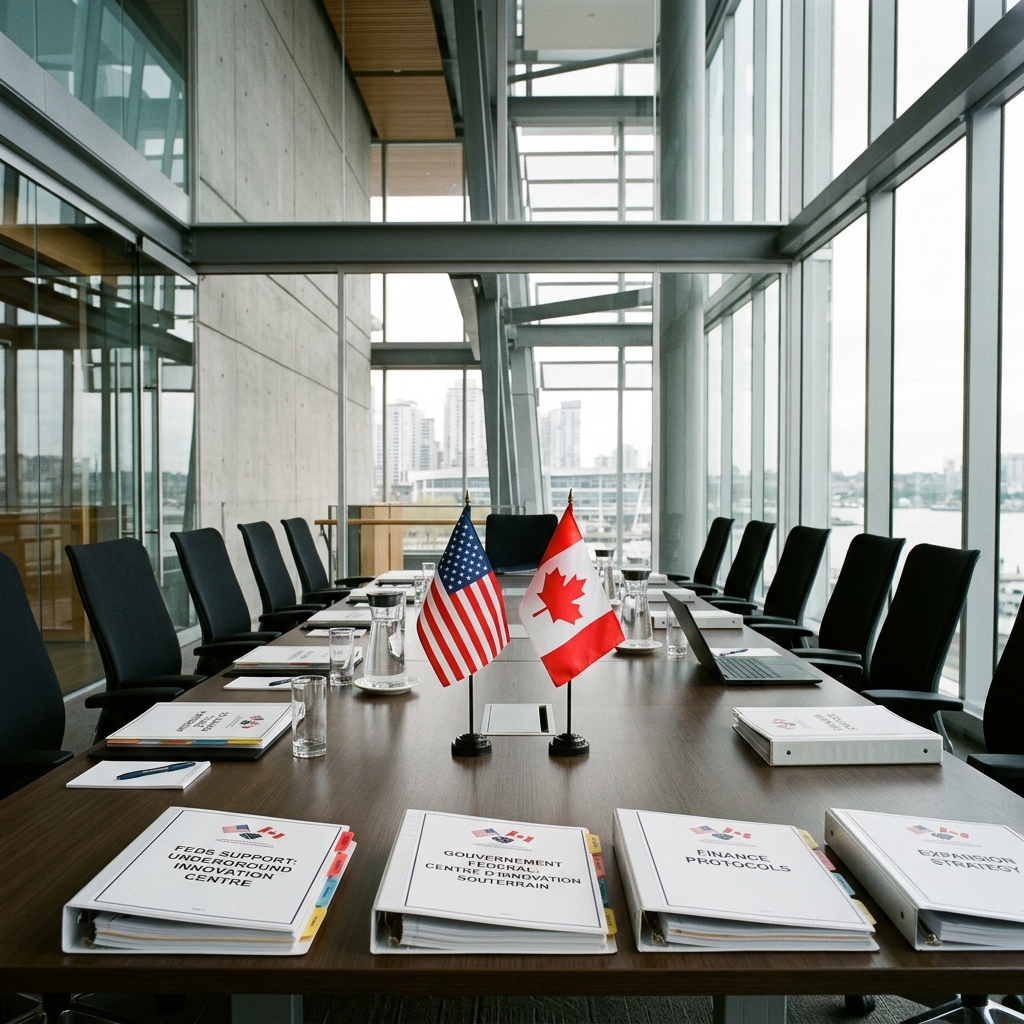
1. Federal Capital Injection Targets Subterranean Commercialization Bottlenecks
The Government of Canada announced a dedicated funding allocation through the Federal Economic Development Agency for Northern Ontario to finance the physical and technological expansion of the underground innovation centre operated by NORCAT in Greater Sudbury. According to reporting by CTV News, this targeted federal capital deployment enhances the operating capacity of the world-leading underground testing facility, where industrial original equipment manufacturers and emerging technology ventures validate subterranean mining hardware. The facility provides an operating subterranean mine environment dedicated exclusively to testing, training, and validating commercial extraction technologies, software, and autonomous electric haulage platforms before market entry.
Federal officials framed the capital injection as an essential component of Canada's broader critical minerals strategy, which requires rapid technological commercialization to lower operating expenditures at deep-ore extraction sites. The expansion addresses a long-standing bottleneck in Canadian natural resource technology: the severe lack of active subsurface environments where private firms can pilot unproven machinery without disrupting commercial production shifts. By expanding the underground operational footprint, Ottawa aims to accelerate the certification timelines for domestic clean technology firms seeking deployment permits across both Canadian provincial jurisdictions and key extraction basins throughout the western United States.
Industry stakeholders note that this federal support arrives amid intensifying capital expenditure pressures on traditional mining firms operating within the Sudbury Basin, including Vale Base Metals and Glencore. Subterranean testing infrastructure significantly de-risks private capital expenditure by validating machinery durability under authentic rock mechanics stresses, geothermal gradients, and high atmospheric pressures. As global battery manufacturers demand cleaner supply chains for raw materials such as nickel, cobalt, and platinum group elements, the upgraded underground innovation centre gives North American tech providers an operational edge over European and Asian competitors in subsurface mining electrification.
2. Cross-Border Equipment Trade and Fleet Electrification Momentum
The expansion of the underground innovation centre directly impacts cross-border industrial equipment trade, serving as a launchpad for Canadian manufacturing innovators exporting to U.S. resource markets. American equipment suppliers and specialized digital mining software firms frequently use the Sudbury site to secure North American safety certifications under Canadian Standards Association and U.S. Mine Safety and Health Administration guidelines. Enhanced subterranean infrastructure allows simultaneous field trials of battery-electric utility vehicles, tele-remote command systems, and autonomous blast-hole drill rigs manufactured by regional producers like MacLean Engineering alongside multinational equipment giants like Caterpillar and Komatsu.
Commercial miners across Nevada, Arizona, and Minnesota face escalating labor shortages and rising ventilation costs, forcing underground operators to replace legacy diesel fleets with zero-emission electric mobile equipment. The expanded underground innovation centre serves as the premier proving ground where cross-border original equipment manufacturers calibrate high-capacity charging architecture and fast-swapping battery enclosures. Because underground testing eliminates the commercial down-time risks of production mines, American industrial customers can examine rigorous performance telemetry collected under verified baseline conditions. This testing framework shortens cross-border procurement cycles and reduces the warranty reserves required by equipment financing syndicates.
Cross-border venture capital allocation into subterranean robotics and industrial automation will also gain traction from this public-sector expansion. Canadian deep-tech firms often struggle to bridge the funding gap between laboratory prototypes and underground deployment, a phase known in venture circles as technology readiness level seven. With expanded testing galleries and enhanced high-bandwidth underground communication networks, startup enterprises can present validated operational metrics to cross-border private equity syndicates. The institutional certainty provided by federal sponsorship reduces underwriting risk for American institutional investors targeting Canadian industrial technology companies operating in the natural resources sector.
3. Regulatory Alignment, Defense Procurement, and Supply Chain Security
From a regulatory and trade policy standpoint, the federal investment reinforces the bilateral United States-Canada Joint Action Plan on Critical Minerals by localizing deep-mining research capabilities within allied borders. Both Washington and Ottawa have prioritized building secure, end-to-end supply networks for critical minerals that bypass non-market producers in East Asia. The underground innovation centre provides the technical proving ground required to standardize extraction methodologies for complex geological deposits. As the United States Department of Defense allocates funding under Title III of the Defense Production Act, Canadian innovation facilities act as force multipliers for allied resource security.
The regulatory alignment extends to environmental, social, and governance standards enforced by North American institutional asset managers and cross-border carbon accounting mechanisms. By proving the viability of battery-electric fleets, autonomous navigation, and digital ventilation-on-demand systems, the underground centre establishes real-world baselines for low-emission extraction. These data-driven operational benchmarks help Canadian and American mining enterprises comply with stringent emissions reporting frameworks established by the U.S. Securities and Exchange Commission and the Canadian Securities Administrators. Transparent subterranean energy metrics ensure that critical minerals extracted in North America maintain a clear market premium over carbon-intensive imports.
Trade administrators also recognize that the development of specialized underground testing capacity creates technical barriers that protect North American intellectual property. Advanced subterranean mining operations increasingly rely on proprietary sensor arrays, algorithmic rock-characterization software, and private fifth-generation wireless networks operating in subterranean voids. By anchoring the development and validation of these advanced cyber-physical systems inside a federally supported Canadian institution, federal regulators reduce the vulnerability of continental extraction infrastructure to foreign industrial espionage. The facility acts as an intellectual property repository that guarantees secure technological standards across the integrated continental defense industrial base.
4. Capital Markets, Regional Economic Restructuring, and Long-Term Outlook
The macroeconomic significance of this expanded innovation centre reflects a structural shift toward regionalized industrial policy in North American capital markets. Public market valuations on the Toronto Stock Exchange and the New York Stock Exchange increasingly favor mining technology companies with certified underground performance records. Institutional lenders require robust empirical validation before issuing project debt for greenfield critical mineral developments, especially those requiring massive capital outlays for underground shaft sinking and haulage development. The federal capital deployed to expand Sudbury's testing infrastructure therefore lowers capital costs for the entire North American mining technology complex.
Regional economic development in Northern Ontario functions as a cornerstone of this federal strategy, linking historical resource extraction hubs with high-value digital manufacturing jobs. Greater Sudbury's transition from an extractive commodity center into an exporter of specialized intellectual property and automation software demonstrates how public infrastructure grants stimulate downstream private sector employment. By maintaining an operating environment that mirrors active production mines, the expanded centre trains miners and engineers on automated equipment, directly addressing structural labor bottlenecks that currently constrain the development of new extraction projects across the Canadian Shield and the American Midwest.
Looking ahead, the long-term utility of this expanded subterranean facility will be judged by its capacity to accelerate commercialization timelines for disruptive exploration technologies. Emerging techniques like autonomous continuous-mining systems and precision in-situ mineral recovery require extensive subsurface trials before institutional mine operators accept commercial adoption risk. With sustained federal support and tightening cross-border regulatory integration, the underground innovation centre establishes an enduring institutional foundation for continental resource sovereignty. The investment confirms that northern industrial centers will dictate the operational standards, safety codes, and technological capabilities of twenty-first-century subsurface extraction across North America.