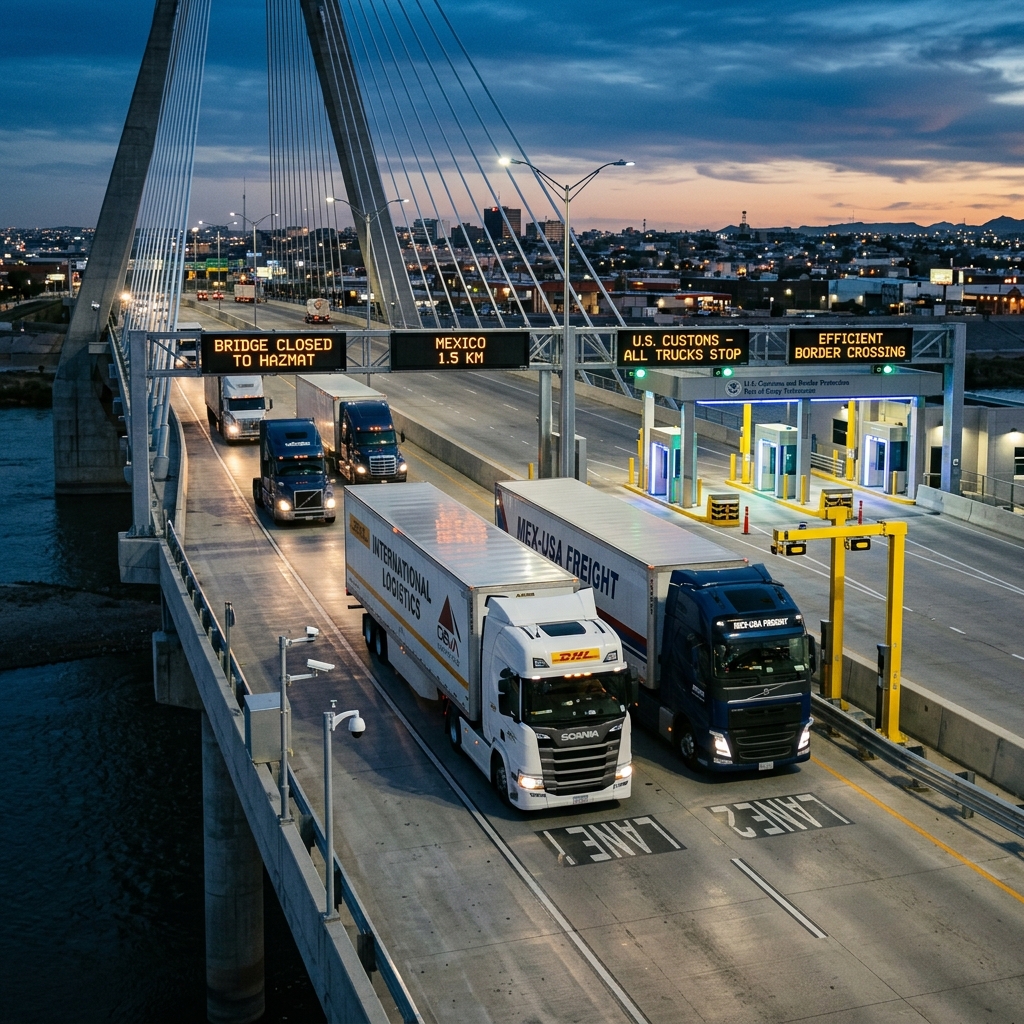
The commercial trade relationship between the United States and Canada represents the world's most integrated bilateral economic conduit, processing over $2.6 billion CAD in goods and services across the shared border every single day.
In 2026, trade operators navigating the United States-Mexico-Canada Agreement (USMCA / CUSMA) have transitioned to next-generation customs automation frameworks deployed by US Customs and Border Protection (CBP) and the Canada Border Services Agency (CBSA).
Key strategic bottlenecks remain concentrated along critical infrastructure links: the Ambassador Bridge and the Gordie Howe International Bridge connecting Windsor and Detroit, alongside the Blue Water Bridge in Sarnia-Port Huron. Commercial carriers utilizing Free and Secure Trade (FAST) programs and pre-cleared electronic manifests (eManifest) achieve border transit times averaging under 12 minutes.
Crucially, automated Rules of Origin compliance algorithms have reduced documentary trade audits by 40%. Importers utilizing digital origin certificates verified against Harmonized System (HS) tariff classification matrices eliminate costly retroactive tariff penalties.
With industrial reshoring across North American semiconductor, automotive battery, and critical mineral manufacturing corridors expanding rapidly, cross-border supply chain integration remains the primary engine of bilateral GDP resilience.