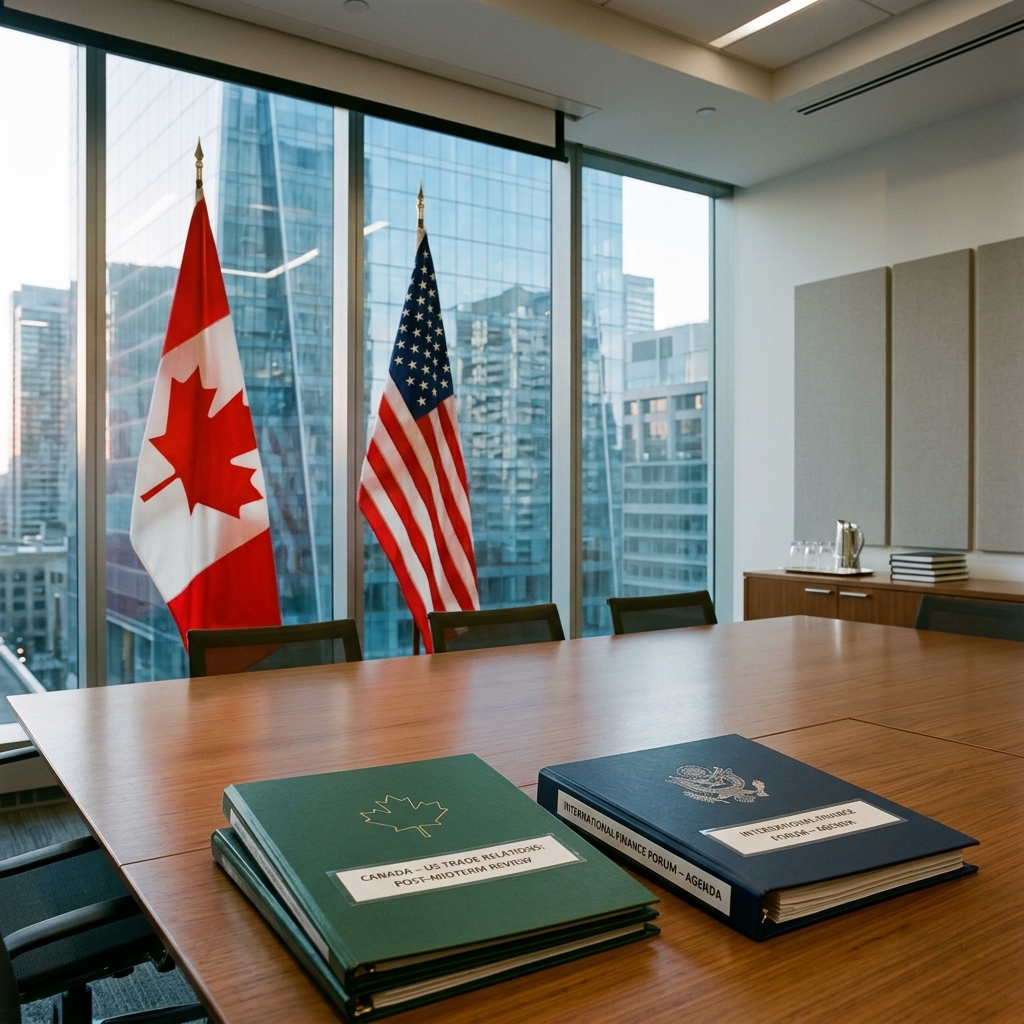
1. Post-Midterm Diplomatic Openings Across the 49th Parallel
Speaking in the wake of the United States midterm elections, former Bank of Canada and Bank of England governor Mark Carney stated that Canada stands ready to embrace any initiatives that re-establish unfettered cross-border commerce. His remarks, reported by Yahoo! Finance Canada, reflect mounting urgency within Ottawa to insulate domestic industries from American industrial protectionism. Carney underscored that open continental supply chains remain indispensable for North American competitiveness, particularly as global commodity markets face persistent structural realignments. His intervention signals to corporate executives in Toronto, Montreal, and Calgary that Canada will actively lobby both Republican and Democratic leadership on Capitol Hill to dismantle newly erected trade hurdles.
Carney highlighted that shifting majorities in the United States House of Representatives and Senate historically generate windows for renegotiating bilateral priorities. The post-midterm balance of power alters the legislative calculus for trade-related committees, including the House Ways and Means Committee and the Senate Finance Committee. Canadian exporters have spent two years contending with stringent domestic content requirements, export licensing uncertainties, and aggressive subsidies that incentivize capital flight south of the border. Carney emphasized that Ottawa must exploit the post-election recalibration to press for comprehensive exemptions, ensuring that Canadian enterprise does not suffer collateral damage from inward-focused American industrial blueprints.
The timing of Carney's intervention holds significant political weight given his role as an informal economic advisor to the federal Liberal government. Ottawa has struggled to present a coherent counterweight to Washington's aggressive state capitalism, which relies on federal funding conditions that sideline foreign partners. By asserting that Canada welcomes any moves to restore free trade, Carney framed bilateral openness not as a concession to foreign interests, but as a mutual economic necessity. The statement provides cover for Canadian trade envoys to initiate high-level outreach to incoming congressional committee chairs, targeting specific regulatory relief before the next presidential election cycle accelerates partisan division.
2. Dismantling the Friction: Buy America, IRA Provisions, and CUSMA Review
At the heart of the friction referenced by Carney lies the expansive application of Buy America provisions across United States federal procurement programs. The Infrastructure Investment and Jobs Act imposed domestic manufacturing requirements on public infrastructure projects, disqualifying Canadian steel, aluminum, and prefabricated structural components from bidding pools. Carney identified these restrictions as self-defeating for American project delivery, because cross-border supply chains have been tightly integrated since the 1965 Auto Pact. Restoring true market access requires technical waivers from the United States Department of Transportation and the Environmental Protection Agency, measures that executive agencies can advance without requiring contentious legislative fights.
The Inflation Reduction Act also introduced major disruptions to integrated continental automotive manufacturing through discriminatory consumer tax credits. While Canadian lobbying secured essential modifications for North American assembly parity, significant ambiguity remains regarding the upstream sourcing of critical minerals and battery components. Carney emphasized that full trade restoration requires clear, durable definitions that treat Canadian nickel, lithium, and graphite deposits as domestic supply under Title III of the United States Defense Production Act. Without explicit cross-border reciprocity, Canadian mining operators in northern Ontario and Quebec risk losing processing investment to state-backed American ventures.
Looking forward to the formal 2026 joint review of the Canada-United States-Mexico Agreement, Carney warned against permitting interim trade skirmishes to harden into permanent protectionist policies. Ongoing disputes over United States access to Canada's supply-managed dairy sector, coupled with retaliatory tariffs on Canadian softwood lumber, continue to degrade bilateral goodwill. Carney pointed out that both jurisdictions face identical threats from overseas non-market economies, making internal trade disputes an inefficient distraction. Canadian negotiators must use post-midterm engagement to resolve these long-standing irritants before statutory review mechanisms trigger formal dispute settlement proceedings under CUSMA Chapter 31.
3. Corporate Investment, Capital Flight, and Cross-Border Manufacturing
The commercial stakes outlined by Carney are exceptionally high for institutional investors and multinational corporations operating on both sides of the border. Canadian manufacturers face capital expenditure decisions distorted by American subsidy packages that dwarf domestic incentives. According to balance sheet data from heavy industrial firms on the Toronto Stock Exchange, capital allocation models increasingly prioritize United States production footprints to secure compliance with domestic procurement mandates. Carney stressed that restoring open trade terms is vital to stem this capital drain, allowing Canadian enterprises to invest domestically with confidence that export access to the American market remains secure.
Integrated supply chains in the Great Lakes manufacturing corridor illustrate the real-world operational costs of post-midterm policy uncertainty. Advanced manufacturing clusters spanning southern Ontario, Michigan, Ohio, and Indiana rely on cross-border logistics systems where components cross the border multiple times before final assembly. Additional administrative compliance burdens or protective border measures add frictional drag, inflating unit costs and degrading global competitiveness against Asian and European industrial conglomerates. Carney noted that restoring tariff-free, red-tape-free transit for intermediate inputs is essential to sustain high-wage employment across the shared manufacturing basin.
Financial institutions and institutional asset managers in Bay Street boardrooms have largely echoed Carney's assessment. Canadian pension funds, which deploy billions of dollars into North American infrastructure and clean energy assets, require predictable regulatory regimes to justify long-term capital deployment. Increased regulatory divergence between the Federal Energy Regulatory Commission and the Canada Energy Regulator threatens to strand cross-border transmission and pipeline projects. Carney argued that removing market distortions and re-anchoring bilateral trade in clear, market-oriented principles provides the stable framework institutional investors need to underwrite complex continental infrastructure assets.
4. Strategic Re-Engagement: Navigating a Divided Washington
Navigating the post-midterm legislative significant requires Ottawa to adopt a targeted, decentralized diplomatic offensive across individual American states. Carney recognized that broader multilateral trade agreements are politically unviable in the current Washington environment, meaning progress will occur through sector-specific protocols and subnational compacts. Canadian provincial premiers and trade attachés must coordinate closely with United States governors in key export-dependent states like Ohio, Illinois, and Pennsylvania. Demonstrating that millions of American manufacturing jobs rely directly on intermediate inputs from Canadian suppliers offers the most potent counter-narrative to domestic protectionist rhetoric.
The Office of the United States Trade Representative, alongside the United States Department of Commerce, will face persistent pressure from domestic industry lobbies to enforce trade remedy laws aggressively. Carney's advocacy for restoring trade highlights the need for Canadian authorities to mount rapid, evidence-based challenges against anti-dumping and countervailing duty petitions. Proactive diplomacy must emphasize that North American energy security, fertilizer supply resilience, and raw material availability depend on friction-free bilateral trade flows. The federal government must ensure its trade defense mechanisms are matched by compelling technical arguments that resonate with congressional representatives focused on controlling domestic inflation.
Carney's proactive message reflects a broader realization: passive reliance on historical goodwill no longer protects Canadian economic interests in Washington. As the United States recalibrates its trade posture following the midterms, Canadian policymakers must present actionable solutions that fit within Washington's economic security framework. Framing Canadian resources, manufacturing expertise, and clean energy as vital extensions of American supply security gives Ottawa its best leverage. Restoring cross-border free trade requires sustained, technically rigorous diplomacy that proves integrated North American commerce provides the ultimate hedge against global economic instability.