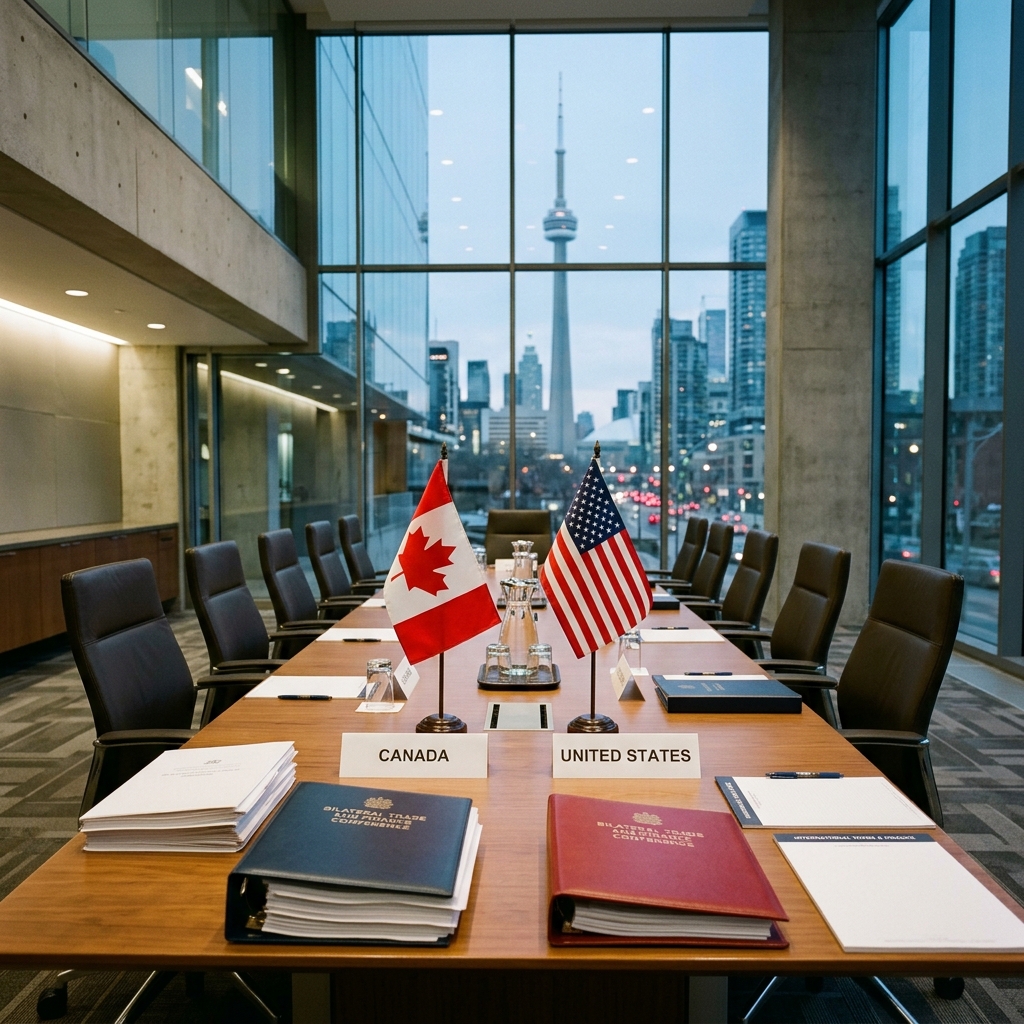
1. Direct Channels and the Compressed Diplomatic Timeline
Mark Carney, acting in his capacity as chair of the federal economic advisory task force for Prime Minister Justin Trudeau, confirmed that bilateral discussions between Canadian officials and President-elect Donald Trump are set to intensify immediately. Following a direct telephone exchange, Carney indicated that working groups will spend the coming weeks addressing trade friction points. The intervention reflects an urgency inside the Prime Minister's Office and the Department of Finance to resolve tariff exposures. Ottawa aims to secure explicit carve-outs before executive orders take effect on day one of the incoming presidential administration.
The timeline established by Carney compresses months of standard diplomatic posturing into a matter of weeks. By engaging Trump directly, Canadian officials are attempting to establish a framework that addresses White House grievances regarding northern border security and trade imbalances. Canadian business leaders from the Business Council of Canada and the Canadian Chamber of Commerce have pushed for early access, arguing that protracted uncertainty would stall capital investment along the Windsor-Detroit corridor. Carney indicated that negotiators will prioritize structural commitments that reassure Washington while protecting integrated supply networks.
Trudeau has increasingly relied on Carney's international credibility, honed during his tenure leading the Bank of Canada and the Bank of England, to interface with Wall Street and Washington trade hardliners. Carney brings analytical authority to a transactional White House. His confirmation of upcoming negotiations signals that Canada will not wait for formal diplomatic protocols. Instead, Canadian trade representatives will operate in New York, Florida, and Washington to craft an actionable preliminary consensus that avoids retaliatory tariff escalation.
2. Preempting Blanket Tariffs on Integrated Industrial Corridors
The primary catalyst for this accelerated dialogue is Trump's threat to impose a universal 25 percent tariff on all Canadian imports. An import levy of that magnitude would cause immediate operational disruption across cross-border industrial operations. The Automotive Parts Manufacturers' Association has repeatedly warned that intermediate components cross the Canada-United States border up to eight times prior to final assembly. Applying statutory border duties via the International Emergency Economic Powers Act would render integrated production unviable, causing auto assembly facilities across Ontario, Michigan, and Ohio to halt operations within days.
Carney's bilateral engagement focuses heavily on illustrating the asymmetric economic damage such measures would inflict on American businesses. United States refineries along the Gulf Coast and throughout the Midwest depend daily on heavy crude shipments from Western Canada via the Enbridge Mainline and the Keystone pipeline network. Imposing tariffs on the daily flow of roughly 4 million barrels of Canadian oil would raise retail motor fuel prices across the United States. Carney is leveraging these physical market realities to argue for sector-specific exemptions covering hydrocarbons, refined petroleum products, and petrochemical feedstocks.
Furthermore, Canadian negotiators are deploying data on primary metals to protect smelters in Quebec and British Columbia. Manufacturers in Pennsylvania, Ohio, and Indiana rely on imported Canadian aluminum and steel to maintain downstream operations. During previous Section 232 tariff disputes, Canadian producers absorbed margin compression while American manufacturers faced sharp price inflation. Carney's upcoming discussions aim to guarantee that primary commodities remain unencumbered by unilateral trade actions, preserving the duty-free protections codified under the Canada-United States-Mexico Agreement.
3. Concessions on Border Enforcement and Digital Services Taxation
To secure a viable agreement over the coming weeks, Canadian negotiators are preparing substantive policy concessions designed to address specific White House demands. Public Safety Minister Dominic LeBlanc has already coordinated with the Canada Border Services Agency to deploy additional surveillance drones, helicopters, and border patrol personnel along the 49th parallel. Trump has explicitly linked trade access to illicit fentanyl interdiction and migration control. Carney's discussions will position Canadian border expenditures as a strategic contribution to continental security, directly satisfying Washington's conditions for normalized trade.
Another central issue in the negotiations is Canada's controversial Digital Services Tax, which imposes a 3 percent levy on foreign technology platforms generating domestic revenues. The Office of the United States Trade Representative previously initiated formal dispute consultations under CUSMA Chapter 31, characterizing the tax as discriminatory against American tech giants like Alphabet, Amazon, and Meta. Canadian fiscal authorities may offer to pause or restructure the enactment of this digital tax in exchange for formal American commitments to respect standard tariff-free status for manufactured manufactured goods.
Negotiators must also address American demands regarding defense spending obligations under NATO guidelines. Washington has repeatedly criticized Canada for failing to meet the target of spending 2 percent of gross domestic product on defense procurement. Canadian interlocutors led by Carney are linking increased defense capital expenditures, particularly Arctic radar modernization and purchases of American-manufactured military hardware, directly to trade protections. Demonstrating procurement commitments to United States defense contractors serves as a pragmatic diplomatic counterweight to trade deficits.
4. Pre-Emptive Realignment Ahead of the 2026 CUSMA Joint Review
The upcoming bilateral negotiations effectively advance the timeline for the mandatory joint review of the Canada-United States-Mexico Agreement scheduled for July 2026. Article 34.7 of CUSMA mandates that all three parties assess the operation of the agreement and confirm its extension for another sixteen-year term. By negotiating direct arrangements with Trump now, Carney aims to eliminate sudden policy shocks and establish clear parameters well before the formal 2026 deadline. This defensive positioning prevents Canada from being blindsided by surprise legislative maneuvers in the United States Congress.
A critical priority for Ottawa during these sessions is disentangling Canadian trade interests from unresolved American trade disputes with Mexico. Washington trade advisors have repeatedly voiced frustration over Chinese electric vehicle producers establishing assembly operations within Mexican industrial hubs to bypass American tariff structures. Carney and the Canadian negotiating team intend to demonstrate that Canada has fully aligned its foreign investment screening protocols with the United States, including matching American 100 percent tariffs on Chinese electric vehicles and 25 percent surcharges on Chinese steel and aluminum.
Financial markets have reacted to Carney's announcement with guarded optimism, reflecting hopes that an early procedural dialogue will stave off disruptive trade policy shocks. The Canadian dollar stabilized against the United States dollar on the foreign exchange market following reports of the call, reversing sharp declines driven by initial tariff anxieties. Corporate treasurers, agricultural exporters, and industrial manufacturers across North America will scrutinize the upcoming multi-week negotiations for verifiable evidence that cross-border commerce will remain anchored in predictable legal frameworks.