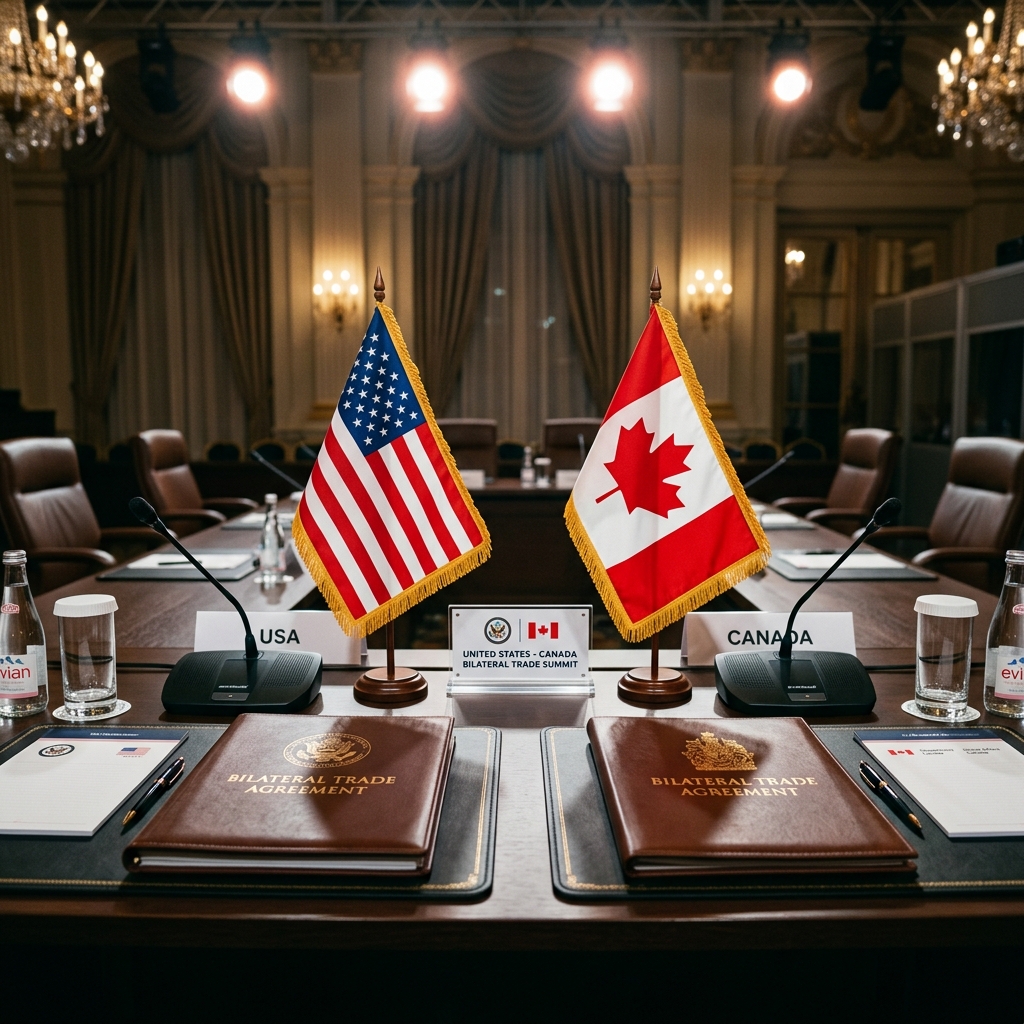
1. Diplomatic Reopening: Carney Engages Trump on Industrial Trade Realities
The report from U.S. News & World Report indicating that Canadian Prime Minister Mark Carney held a productive trade conversation with Donald Trump marks a critical inflection point for bilateral economic diplomacy. Carney, whose central banking pedigree spans both the Bank of Canada and the Bank of England, deployed a pragmatic tone that diverged from past rhetorical clashes. The discussion arrived amid persistent threats of universal baseline tariffs from Washington. Carney signaled to Ottawa markets that bilateral commerce requires immediate technocratic engagement rather than passive reliance on multilateral treaties.
Corporate suites across Toronto and New York scrutinized the exchange for indications of how Carney intends to insulate integrated supply chains from executive trade actions. Carney understands the mechanical vulnerabilities of Canadian export industries. More than three-quarters of national merchandise exports head across the southern border daily. By initiating high-level communication early, the prime minister sought to anchor discussions on shared economic interests, emphasizing shared North American industrial defense, capital expenditures in advanced manufacturing, and reciprocal access to essential heavy raw materials.
The timing of the communication highlights Canada's heightened anxiety over protectionist rhetoric emerging from the incoming United States administration. Industry leaders representing the Canadian Council of Chief Executives and the Canadian Manufacturers & Exporters observed that Carney used the exchange to reaffirm the foundational architecture of the Canada-United States-Mexico Agreement (CUSMA). The call established an operational communication channel between Carney's cabinet team and Trump's inner economic circle, aiming to prevent destabilizing unilateral tariff declarations before formal diplomatic negotiations commence.
2. Enterprise Technology and High-Performance Compute Infrastructure
While traditional trade disputes frequently center on agricultural quotas, steel allocations, and automotive assembly percentages, the Carney-Trump conversation carried distinct ramifications for the cross-border enterprise technology and artificial intelligence corridor. Carney has positioned advanced computing as an engine for national productivity growth. This objective depends entirely on unfettered access to American-designed silicon accelerators, software architectures, and capital investments. Maintaining an open digital border remains non-negotiable for Canadian enterprise tech firms expanding outward from the Waterloo-Toronto tech triangle.
The cross-border computing axis operates under tight structural interdependence. American hyper-scalers like Microsoft, Amazon Web Services, and Google require vast, steady access to clean electrical baseloads to power their next-generation data server farms. Quebec and Ontario possess the carbon-free hydroelectric capacity and nuclear grids essential for training complex foundational models without busting corporate net-zero pledges. Carney highlighted these integrated energy-compute synergies, presenting Canadian utility networks as natural infrastructure partners to American technology firms rather than competitive rivals.
Trade barriers targeting intellectual property, specialized engineering labor, or cloud hardware components would severely stall enterprise AI adoption in North American manufacturing. Carney's productive call aimed to ensure that forthcoming digital trade debates do not compromise the free flow of algorithmic models and cross-border computational data storage. Enterprise software leaders in Montreal and Vancouver viewed the report as a stabilizing indicator, reducing the risk of sudden national security review hurdles on outbound technology services and joint artificial intelligence ventures.
3. The 2026 CUSMA Joint Review and Rules-of-Origin Mechanics
The broader context of the Carney-Trump exchange is shaped by the statutory review requirement of CUSMA scheduled for 2026. Article 34.7 of the agreement mandates that all three signatory nations evaluate the treaty to determine its extension for an additional sixteen-year term. Under a second Trump administration, the Office of the United States Trade Representative will seek substantial structural concessions. Washington targets stricter regional value content definitions, tighter limits on Chinese intermediate capital goods, and revisions to dispute settlement panels outlined under Chapter 10.
Carney's diplomatic outreach prepares the Canadian civil service for intense technical negotiations over product classification codes. By establishing direct personal rapport with Trump, Carney attempts to build negotiating space around critical industrial inputs, including lithium extraction, permanent magnets, and microelectronics packaging. The prime minister understands that a defensive, legalistic posture will fail against Trump's transaction-heavy negotiating approach. Instead, Canadian trade negotiators are framing their supply chains as direct extensions of domestic American security interests, particularly regarding dual-use enterprise technologies and robotic tooling.
Financial institutions on Bay Street and Wall Street monitored currency markets following the U.S. News & World Report scoop, tracking movements in the Canadian dollar against the greenback. The currency had faced downside pressure due to widening interest rate differentials between the Bank of Canada and the Federal Reserve, combined with structural tariff risk premiums. Carney's characterization of the conversation helped temper immediate market volatility, providing sovereign debt traders and foreign exchange desks a baseline expectation of managed, bilateral dealmaking rather than unhedged trade conflict.
4. Energy Grid Interconnections and Capital Expenditure Forecasts
Beyond computing, the trade dialogue directly touches the integration of North American high-voltage power grids, crude transportation networks, and critical mineral processing. Carney's extensive background in climate transition finance equips him to discuss energy infrastructure as hard trade capital. Trump's industrial platform demands cheap, continuous energy to support domestic re-industrialization, algorithmic processing centers, and high-tech foundries. The physical transmission lines moving hydro power southward from Hydro-Quebec into New England and New York state provide Canada with formidable economic leverage in bilateral negotiations.
Institutional infrastructure investors require regulatory certainty before deploying multi-billion-dollar outlays into cross-border electrical interconnections, micro-grid corridors, and pipeline interties. A breakdown in trade goodwill would freeze these major private equity deployments and syndicated lending facilities. Carney's conversation was designed to assure institutional infrastructure sponsors that cross-border energy transport and resource corridors will not face arbitrary punitive border adjustments under revised United States tariff regimes or reciprocal foreign revenue tax applications.
The operational path forward demands converting this cordial bilateral discussion into concrete working group protocols between Canadian trade ministers and incoming American cabinet officials. Carney must navigate sensitive domestic political balances, maintaining Canada's environmental commitments while addressing Trump's demands for deregulated industrial execution and energy parity. The success of Carney's trade policy will ultimately be measured by whether enterprise technology platforms, advanced manufacturers, and cross-border logistics systems can operate without disruptive supply friction throughout the forthcoming CUSMA modernization cycle.