1. Tariff Volatility and the 2026 CUSMA Reassessment Pressure Point
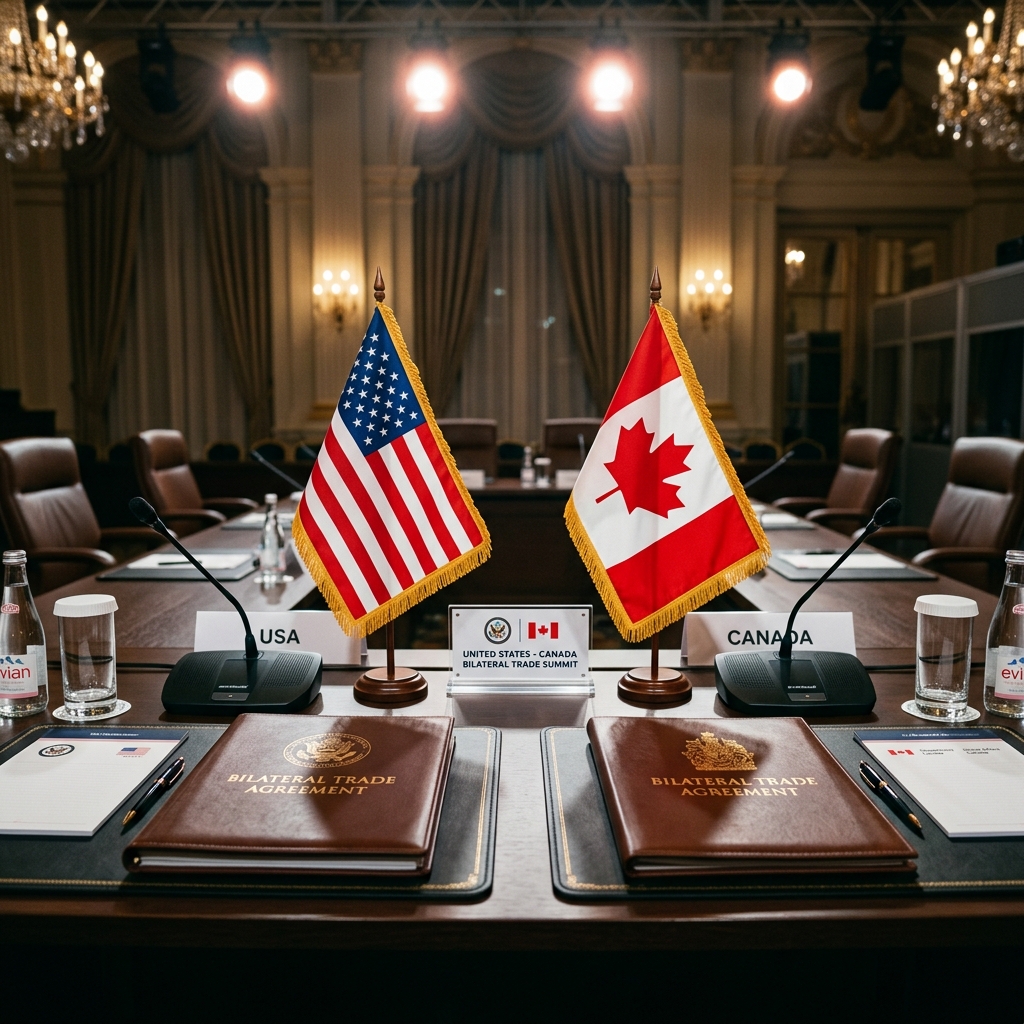
Trade policymakers within the Department of Finance Canada and Global Affairs Canada are preparing strategic contingency plans ahead of the scheduled 2026 joint review of the Canada-United States-Mexico Agreement. Escalating statutory protectionism in Washington, driven by aggressive domestic content thresholds under the Inflation Reduction Act and persistent rhetoric surrounding universal baseline import duties, has forced Canadian trade officials to reconsider structural overreliance on the American export corridor. Historically, more than seventy-five percent of domestic merchandise exports cross the southern land border, leaving key industrial sectors vulnerable to shifting legislative majorities on Capitol Hill.
The economic frictions extend far beyond political rhetoric. Canadian corporate legal teams and cross-border trade desks are currently grappling with expanded Buy America criteria under the Infrastructure Investment and Jobs Act, which restricts Canadian structural steel, aggregate, and manufactured equipment from participating in federally subsidized state projects. Furthermore, unresolved disputes regarding dairy tariff-rate quotas under Chapter 31 of CUSMA and ongoing United States Department of Commerce anti-dumping duties on Canadian softwood lumber continue to degrade traditional bilateral goodwill. These friction points demonstrate that continental trade pacts no longer guarantee unimpeded commercial access.
To mitigate systemic downstream exposure, International Trade Minister Mary Ng has mandated that trade commissioners across Western Europe deepen commercial integration through existing preferential trade channels. The federal objective involves lifting export diversification benchmarks, systematically directing corporate balance sheets toward the twenty-seven member states of the European Union. While bilateral commerce with the United States represents nearly nine hundred billion Canadian dollars annually, Ottawa recognizes that sovereign economic resilience demands an institutional counterweight. European capitals, facing their own supply vulnerabilities following geopolitical disruptions in Eurasia, present an immediate institutional alignment.
2. Maximizing CETA Channels Across Critical Mineral and Energy Corridors
The primary regulatory vehicle for Ottawa's European pivot is the Comprehensive Economic and Trade Agreement, which has operated under provisional application since September 2017. Despite the elimination of customs tariffs on ninety-eight percent of industrial and agricultural tariff lines, domestic mid-market exporters have underutilized CETA due to complex rules-of-origin documentation and the geographic convenience of cross-border trucking corridors. Federal economic development agencies are now funding direct compliance programs to educate Canadian resource executives on navigating European Union technical standards, conformity assessments, and bilateral investment protocols to capture untapped continental demand.
Critical minerals form the core foundation of this transatlantic reallocation. As European automakers such as Volkswagen AG, BMW, and Stellantis scramble to comply with the European Union Critical Raw Materials Act, Canadian extraction projects are securing significant foreign direct investment. The James Bay lithium corridor in Quebec and the Ring of Fire mineral belt in Northern Ontario have attracted direct inspection visits from German industrial delegations seeking battery-grade lithium, nickel, and cobalt. By structuring long-term off-take agreements with European battery manufacturers, Canadian junior and intermediate mining firms are insulating their capital expenditure plans from prospective American border adjustments.
Energy security dialogues have similarly evolved from high-level political communiques to formal industrial joint ventures. The federal government has fast-tracked regulatory assessments under the Impact Assessment Act for clean hydrogen and ammonia conversion facilities situated along the Atlantic seaboard, particularly in Newfoundland and Labrador and Nova Scotia. These coastal terminals are engineered specifically to supply industrial hubs in the Port of Rotterdam and Port of Hamburg. With European utilities seeking stable, democratic energy partners, Canadian green hydrogen developers are utilizing CETA institutional investment chapters to raise institutional capital outside the US municipal bond network.
3. Transatlantic Logistics Infrastructure Versus Continental Rail Realities
Transitioning Canadian export flows from North American rail intermodals to Atlantic container terminals presents acute logistics and pricing frictions. The integrated Class I rail operations of Canadian National Railway and Canadian Pacific Kansas City offer seamless, direct freight transit to industrial distribution centers in Chicago, the Gulf Coast, and central Mexico. In contrast, routing agricultural bulk goods, automotive components, and processed chemicals through the Port of Montreal, the Port of Halifax, or Port Saint John introduces maritime freight volatility, transshipment tariffs, and extended delivery cycles that challenge competitive pricing.
Logistics managers at major domestic manufacturers note that shipping a forty-foot equivalent unit from Southwestern Ontario to Rotterdam frequently costs substantially more than routing identical cargo to Houston via existing rail sidings. Although the Port of Montreal has advanced significant infrastructure investments to expand container capacity at the Contrecoeur terminal, ongoing dockworker labor disputes and seasonal Saint Lawrence Seaway draft restrictions impose operational constraints. Transatlantic supply chains demand higher inventory carrying costs and complex currency hedging strategies between the Canadian dollar, the euro, and the British pound, forcing corporate treasurers to adapt balance-sheet models.
Furthermore, regulatory divergence between Washington and Brussels complicates domestic factory retooling. Manufacturers attempting to supply both markets encounter disparate product compliance regimes. The European Union requires strict compliance with REACH chemical authorizations, the Corporate Sustainability Due Diligence Directive, and comprehensive waste electrical equipment standards. Conversely, American regulators enforce separate United States Environmental Protection Agency rules and National Highway Traffic Safety Administration codes. Canadian industrial facilities must decide whether to absorb the capital expenditures required to maintain parallel production lines or selectively prioritize one trading jurisdiction.
4. Regulatory Friction: EU Deforestation Mandates and Border Carbon Levies
Ottawa's commercial embrace of Europe faces significant headwinds from the European Union regulatory architecture itself. The impending implementation of the European Union Deforestation Regulation represents an immediate statutory risk for Canadian forestry, pulp, and paper operators. Despite British Columbia, Ontario, and Quebec maintaining sustainable forestry regimes governed by provincial crown land tenures, EUDR imposes rigid satellite plot geolocation requirements that classify standard Canadian commercial forestry cut-blocks alongside high-risk tropical deforestation zones. The Forest Products Association of Canada has formally petitioned Brussels for equivalency status, but negotiations remain deadlocked.
The European Union Carbon Border Adjustment Mechanism presents an additional layer of cross-border financial friction. While Canada maintains an economy-wide statutory carbon pricing system under the Greenhouse Gas Pollution Pricing Act, the federal output-based pricing system allocates performance credits that diverge mathematically from the European Union Emissions Trading System. Importers of Canadian primary aluminum, steel, and chemical fertilizers into the European common market face burdensome reporting obligations and potential import surcharges during the CBAM definitive implementation phase. Canadian corporate tax departments must reconcile disparate carbon accounting methodologies to preserve existing margin advantages over unpriced competitors.
The unresolved ratification status of CETA among specific European national legislatures also casts long-term institutional doubt on full investor-state treaty protections. Ten member states, including major industrial hubs such as France and Italy, have delayed or rejected formal domestic parliamentary ratification of the agreement's Investment Court System. While provisional application safeguards commercial goods and services access indefinitely, Canadian institutional funds, such as the Canada Pension Plan Investment Board and Caisse de depot et placement du Quebec, must structure European corporate acquisitions through jurisdictions with ratified bilateral investment treaties, introducing regulatory complexity into outward foreign direct investment.