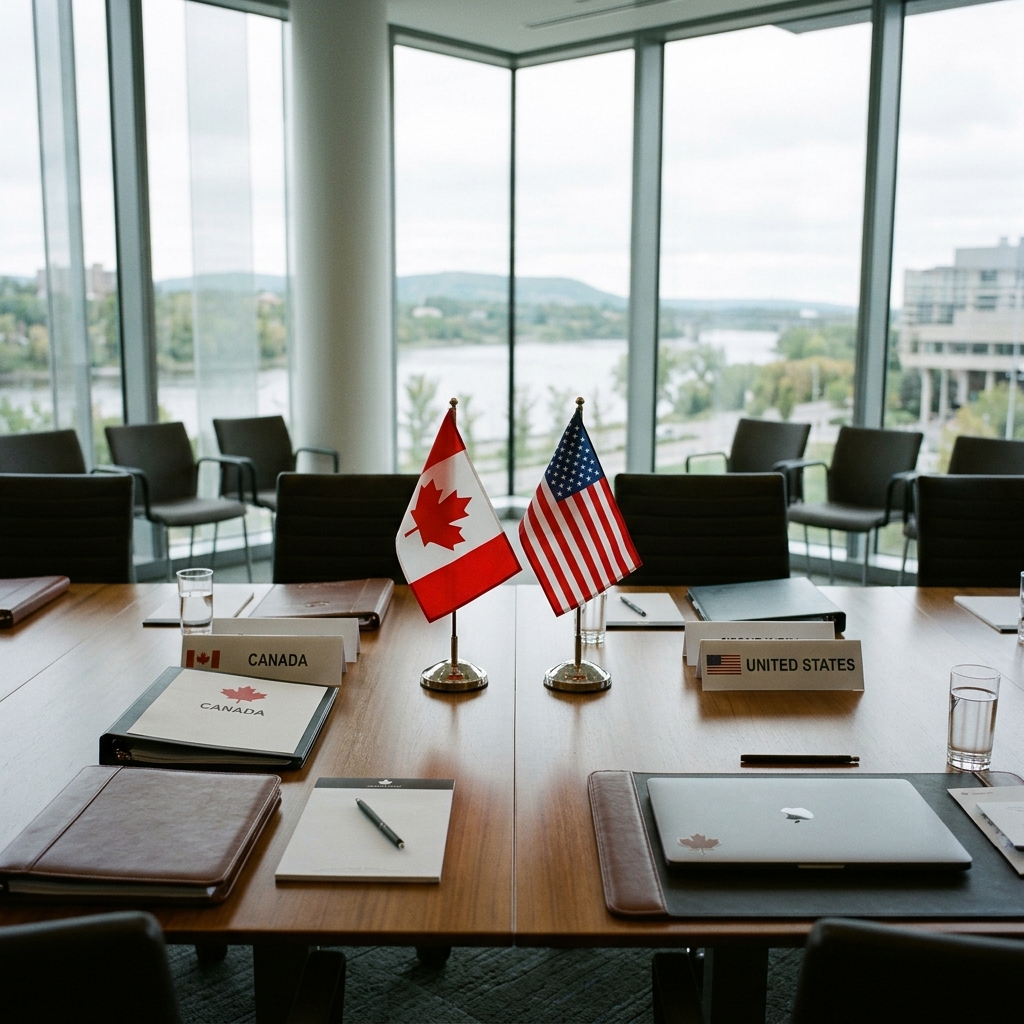
1. The Middle Power Doctrine and Ottawa's Diversification Mandate
Speaking on Canada's evolving external commercial policy as reported by U.S. News and World Report, federal minister Anita Anand articulated a calculated return to middle power diplomacy through targeted trade architecture. The Canadian government is confronting a global trading system fragmented by industrial subsidies and geopolitical division. For Ottawa, the middle power concept is no longer a purely diplomatic posture rooted in post-war multilateralism; it is an economic defense mechanism. By negotiating plurilateral and bilateral pacts across non-traditional markets, Canada seeks counterweights to rising protectionist currents in both Washington and Beijing.
The economic arithmetic driving Anand's remarks remains stark. Canada directs more than three-quarters of its merchandise exports across the southern border to the United States. That concentration creates severe structural exposure to American legislative shifts, including stringent Buy America requirements under the federal Infrastructure Investment and Jobs Act and domestic assembly incentives within the Inflation Reduction Act. Anand indicated that Canada must systematically construct counter-cyclical trade channels. Global Affairs Canada and the Trade Commissioner Service are focusing resources on markets that value statutory certainty, rule-of-law governance, and resource security.
This strategic pivot relies on a dual-track framework: deepening ties with dependable democratic trading partners while aggressively pursuing high-growth developing markets. The Department of Finance and the Treasury Board are aligning procurement and economic resilience initiatives to support outbound exporters. Ottawa is attempting to convert its institutional stability and mineral wealth into long-term diplomatic leverage. The strategy seeks to ensure that sudden bilateral disruptions in Washington do not paralyze Canadian industrial producers, manufacturing clusters in southern Ontario, or primary resource extractors in the western provinces.
2. Indo-Pacific Alignments, ASEAN Accords, and the CPTPP Frontier
Central to Anand's thesis is the operationalization of Canada's Indo-Pacific Strategy, supported by a 2.3 billion Canadian dollar budgetary allocation designed to rebalance trade flows through 2027. Negotiations for a Comprehensive Economic Partnership Agreement with Indonesia represent the nearest milestone, with negotiators targeting tariff rationalization across agricultural commodities, advanced manufacturing, and commercial engineering services. Concurrently, Canada is pressing forward on a comprehensive free trade agreement with the Association of Southeast Asian Nations. These markets offer demographic expansion and industrial scale that Canadian commercial banks and institutional pension funds are eager to access.
The Comprehensive and Progressive Agreement for Trans-Pacific Partnership serves as the statutory anchor for this outward expansion. As founder members evaluate new accession applications, Ottawa is insisting on high-standard compliance regarding digital trade chapters, labor standards, and the elimination of non-tariff barriers. Anand emphasized that Canada's middle power leverage relies entirely on preserving enforceable rules-based mechanisms. By reinforcing the CPTPP architecture alongside partners such as Japan, Australia, and Singapore, Canada creates a predictable legal environment for corporate capital allocation that bypasses bilateral coercion from dominant global superpowers.
Canadian agricultural exporters, notably canola growers across Saskatchewan and beef producers in Alberta, view these cross-regional pacts as vital shock absorbers. Historically, arbitrary trade bans, sanitary restrictions, and politically motivated border closures have disrupted Canadian commodities. Deepening access to Southeast Asian supply networks through formal treaty provisions provides Canadian trade desks with diversified pricing power. Export Development Canada has matched this diplomatic push by widening political risk insurance and commercial debt underwriting for Canadian mid-market enterprises expanding into emerging Asian transit hubs.
3. Strategic Hedging Ahead of the 2026 CUSMA Joint Review
While Anand focused on new trade frontiers, every diversification effort undertaken in Ottawa operates in the shadow of the Canada-United States-Mexico Agreement. Article 34.7 of CUSMA dictates a formal joint review of the accord in 2026, an inflection point that could trigger renegotiation or sunset clauses. Trade specialists in Ottawa and Washington recognize that building alternative trading partnerships is a conscious hedging operation. Demonstrating that Canadian critical commodities, agricultural goods, and manufactured components have ready buyers across Europe and the Pacific Rim strengthens Canada's bargaining posture against potential cross-border tariff threats.
Protectionist rhetoric within the United States Congress continues to pressure the bilateral economic relationship. Unresolved disputes surrounding the Canadian digital services tax, automotive rules of origin compliance, and Canada's supply-managed dairy sector demonstrate persistent friction points across the 49th parallel. Anand's assertions reflect a broader realization in the federal cabinet that unreciprocated integration leaves Canadian supply chains vulnerable. Expanding treaty frameworks outside North America ensures that multinational firms investing inside Canada can utilize the country as a multi-directional export platform, rather than merely an upstream supplier to the American Midwest.
The cross-border corporate sector is watching this repositioning carefully. American automakers and defense contractors depend heavily on deeply integrated cross-border component manufacturing governed by the auto rules of origin under CUSMA. If Canada successfully inks preferential arrangements with Asian and European economies, it introduces alternative destinations for intermediate components and refined raw materials. This structural diversification forces trade policy officials in Washington to view Canada not as an economic client state, but as an autonomous partner with genuine global market alternatives.
4. Critical Minerals, Foreign Subsidies, and Investment Screening
A cornerstone of Anand's middle power trade strategy involves critical minerals and the realignment of upstream extraction value. Under revised provisions of the Investment Canada Act, Ottawa has enacted rigorous national security reviews, effectively prohibiting Chinese state-owned enterprises from acquiring stakes in Canadian lithium, nickel, graphite, and rare-earth assets. Anand emphasized that Canada is positioning itself as the clean-energy and technology supply chain partner of choice. By establishing bilateral critical mineral pacts with Japan, South Korea, and the European Union, Canada is converting statutory security screening into trade opportunity.
This dynamic directly affects the United States, which seeks friend-shored critical minerals to power electric vehicle mandates and defense manufacturing under the Defense Production Act Title III authorities. However, by establishing direct trade linkages with European and Asian buyers, Canada avoids becoming a captive supplier to American domestic buyers. The Critical Minerals Strategy, backed by 3.8 billion Canadian dollars in federal support, links regulatory approvals, infrastructure development, and international export agreements, ensuring Canadian mining jurisdictions retain pricing parity across diversified global terminal markets.
Executing this strategy demands balancing national security compliance with the reality of international capital markets. Bay Street financial institutions, which finance global junior mining firms, require deep capital pools to develop remote deposits in the Ring of Fire and the Northwest Territories. Restricting autocratic capital requires replacing it with foreign direct investment from allied democracies. Through institutional agreements negotiated under the middle power banner, Anand and her cabinet colleagues are working to channel capital from institutional asset managers across Europe and democratic Asia into Canadian resource extraction and processing corridors.