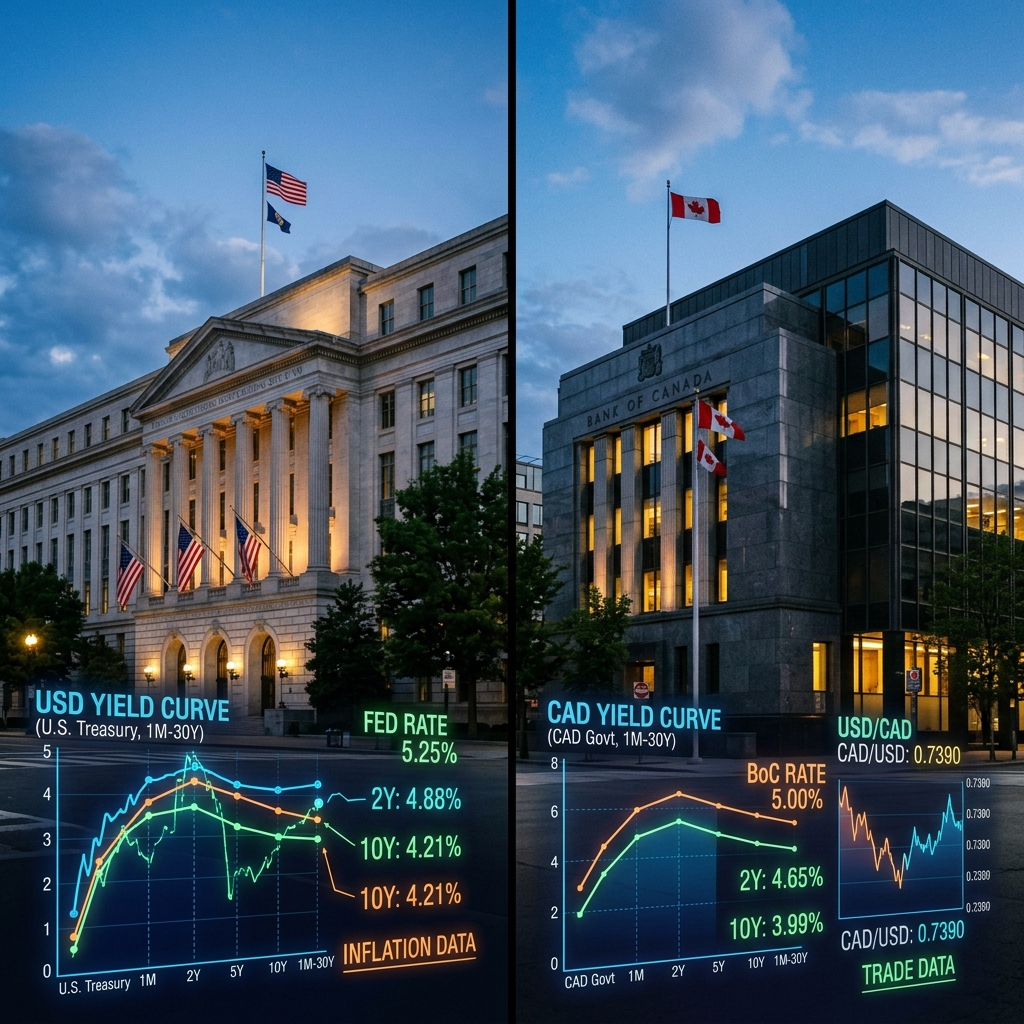
1. The 100 Basis Point Policy Delta: Why Ottawa Cut Faster Than Washington
The structural divergence between North American monetary authorities has emerged as the defining macroeconomic narrative of 2026. The Bank of Canada aggressively front-loaded rate reductions to insulate domestic households against a wave of 5-year fixed mortgage renewals originating during the 2020-2021 low-rate environment.
Conversely, the US Federal Reserve has maintained a resilient 'higher-for-longer' stance, supported by robust US consumer spending, persistent services-sector wage growth, and fiscal expansion.
This 100 basis point policy rate spread represents the widest macroeconomic divergence observed between the two neighboring central banks since the 1990s.
2. FX Dynamics: The Canadian Dollar (Loonie) Under Pressure
Interest rate differentials dictate global capital flows. With US Treasury yields offering significant real yield premiums over Government of Canada (GoC) benchmark bonds, institutional asset managers have steadily rotated liquid balances into USD-denominated sovereign paper.
The Canadian Dollar has settled into a persistent trading range between 1.3900 and 1.4250 per US Dollar. While a depreciated Loonie acts as a natural stimulus for Canadian manufacturing and energy exports to the US, it significantly inflates the cost of imported machinery, enterprise software, and consumer goods.
Currency strategists anticipate that any further unilateral rate cuts by the Bank of Canada without corresponding Fed easing will test historical support levels near 1.4500.
3. Cross-Border Mortgage Arbitrage for Canadian Property Buyers
For Canadian high-net-worth individuals and cross-border corporations holding substantial US dollar revenue streams, the current macroeconomic landscape provides a unique strategic window.
US 30-year fixed residential mortgage rates have stabilized between 5.35% and 5.75%. Unlike Canadian mortgages—which typically require full interest rate renegotiation every 5 years—US mortgages permit borrowers to lock in financing terms for the entire three-decade amortization schedule without balloon reset risks.
Cross-border banking specialists (such as RBC Bank US and TD Bank USA) enable Canadian borrowers to qualify for US properties using Canadian liquid assets and domestic credit histories without mandatory conversion into USD at unfavorable spot rates.
4. Long-Term Portfolio Allocation & Dual-Currency Strategy
Wealth managers operating across Vancouver, Calgary, Toronto, and New York universally recommend adopting a formalized dual-currency balance sheet.
Holding a minimum of 30% to 50% of liquid reserves in US Dollar high-yield savings or Treasury bills insulates cross-border families against persistent Canadian currency depreciation while providing immediate capital to execute opportunistic real estate acquisitions across the US Sunbelt.
As both central banks navigate late-cycle economic dynamics, precision debt-structuring and active FX risk management remain the cornerstone of institutional cross-border wealth preservation.